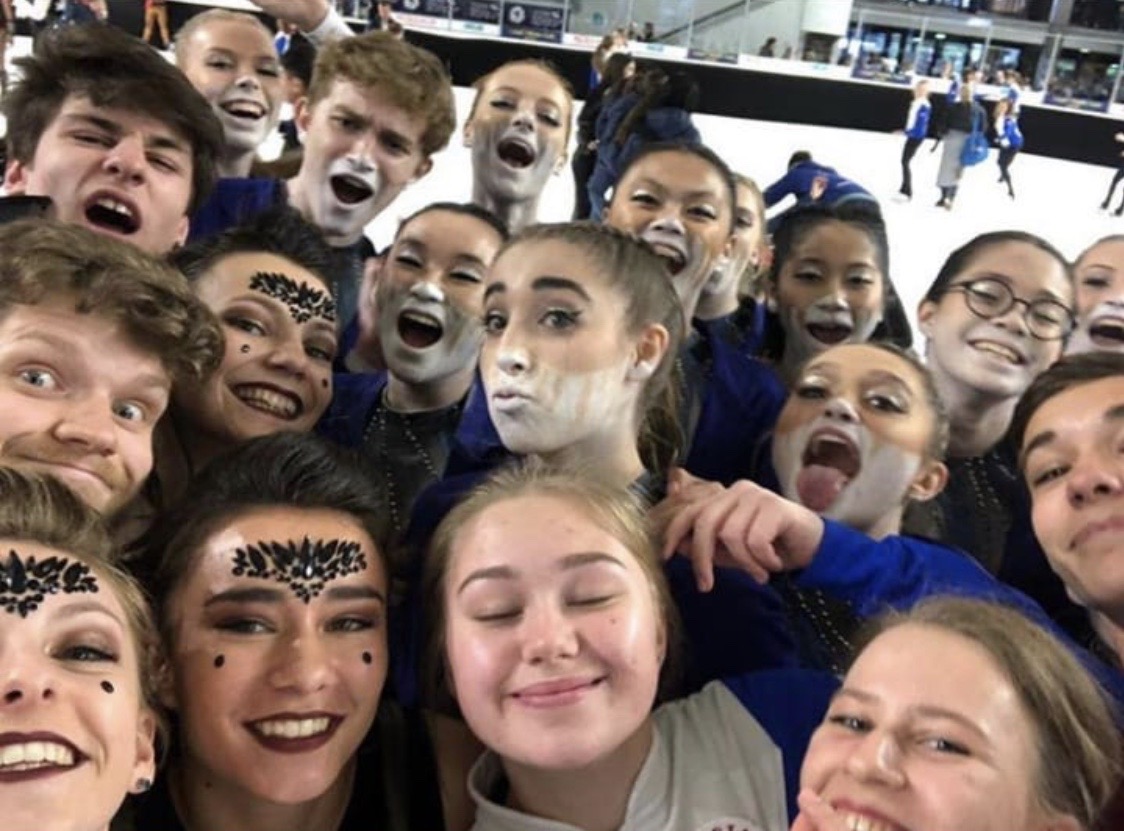
One of these teams, Nadiia Bashynska and Peter Beaumont, showed tremendous improvement coming out of their debut junior season and achieved immediate success, winning the 2019 Lake Placid Ice Dance International and being the only skaters representing a country other than Russia to earn a medal, bronze, at the Junior Grand Prix event in Chelyabinsk, Russia. The couple trains outside of Toronto, under the coaching team of Carol and Jon Lane, Juris Razgulajevs, and Marc-André Servant. There they get the opportunity to train alongside several couples ranging from novice to senior, including Piper Gilles and Paul Poirier as well as Molly Lanaghan and Dmitre Razgulajevs.
I had the pleasure of sitting down and talking to Nadiia and Peter about the origin of their partnership, their development as a couple, and more. They're two incredibly kind people and conducting this interview was a great way to distract myself from everything going on in the world right now. I hope this can help you do the same!
*Responses have been edited for clarity.
 |
| Photo courtesy of Daphne Backman and Ice-dance.com |
N: I think I started skating because I was sick when I was younger, so my mom put me in figure skating to get better. Then, when I got older, when I was like 5, I kind of started liking performing and the feeling of competing and placing, although I never placed, but when it happened it was really nice, so I kind of stuck to it. I was doing singles skating at first, when I was younger. Then I moved to ice dance because I hated jumping, pretty much. That's just the way it is, and I kind of don't remember doing anything else except skating.
P: When I started skating, I was actually quite a late bloomer to it, so I started skating when I was 8. At first I was into athletics, so I was doing multiple sports like track and field, all that sort. The teacher for the class on one of the mornings wasn't in, and across the road there was an ice rink, so one of the receptionists said "Oh, we'll take all the classes and go skating for an hour instead of doing athletics." That's how it all started. I started in the Skate UK program, which I think still is in the UK now, gradually went my way up, and decided that that was what I wanted to do.
How did your partnership begin?
N: It was a really long process, actually. I found Peter through Ice Partner Search. It's actually a really helpful app. I found him through that and we kind of emailed him. (Looking to Peter) I don't think you ever replied to our email. (laughs)
P: I broke up with my partner not as recently as you had, so you were looking for a partner a bit longer than I was.
N: I was looking for a partner for a whole year, so I didn't know if I was going to still skate.
P: I was looking for a partner for about 4 months, and I was at the British Championships that year, which I was supposed to be competing at, but obviously I didn't. Our coach Jon was there at the British Championships with another team that he had, and he obviously mentioned Nadiia. The next year, from November to January, that January I went to a tryout, skated, and that was that.
N: I had tried out with a few guys before, and when Peter came, on the first session I was like "Wow, it's never felt so good before." It just felt like it was the right thing.
P: She's just being nice now. (laughs)
N: No no no! No, I've told you several times, it was just really cool and I had never felt that before. Right away, it was a good partnership.
P: We were saying how quick it was. I had split up with my partner that November, and I had started skating with Nadiia in January, but then we really started properly training in June, because I had my English exams, and once I had finished those, two days after my final exam, that was that, I moved over. I've been here ever since.
N: Yeah, it's been really fast.
So Nadiia, you had already been in Ontario?
N: Yeah, I had been in Canada before Peter moved for one and a half years. Almost two when he moved here, so skating with me it was almost two years. At that point before I met Peter I was seriously deciding to quit and go to ballet as another thing I was going to do, but because Peter came and it was really good, I stuck to skating.
 |
| Photo Courtesy of Daphne Backman and Ice-dance.com |
P: Nope.
N: Nope.
P: You were supposed to get your citizenship.
N: Yeah, I was supposed to get it on the 31st of March, but because of COVID-19, I can't. It's cancelled, probably postponed until May, or June, or whatever, like when it's going to get better. Then, I'm going to be a Canadian citizen, but Peter is only trying to get his permanent residency.
P: I've applied for residency, so hopefully that shouldn't take quite as much time.
So how did you end up choosing to represent Canada?
N: Mainly, I think you moved because of me, and I moved because of the lifestyle. If you look into Ukraine and the history of all the skaters, there's a lot of good skaters that moved away to different countries. It's sad, but there's not a lot of potential, like these countries like Canada, America, Germany, other countries, you have a little bit more potential, in terms of funding...
P: It's like Aljona [Savchenko], right? She's Ukranian.
N: Yeah, and a lot of other teams right now, like my friends, have moved to all other countries.
P: Avonley's partner Vadym [referring to Avonley Nguyen and Vadym Kolesnik] is Ukrainian.
N: Vadym! He was my best friend when I was younger, and we knew each other so well. Well, we still do, but we don't talk as much. Things changed.
P: But you were moving countries.
N: Yeah, and now he's in America, I'm in Canada. Things do change a lot.
P: And with me and the UK, the federation has been changed recently, not to my knowing, but through people telling me. It was called NISA, National Ice Skating Association, which got copyrighted for a food store in the UK, which isn't as big as Walmart or whatever you want to call a grocery store. So they had to change the name of it, because nobody had really heard of it, and they changed it to British Ice Skating, which made more sense.
The federation before was, to put it this way, they'd give you options for Grand Prixs and then you'd be a bit more like "Are we going to be able to this or aren't we going to be able to do it?" you know? We decided that Skate Canada, for us, worked better. You know, we're in the country, there's more opportunities for us here so, yeah, we decided to take that.
N: Yeah, I moved to Canada purely because my dad just didn't want to stay in Ukraine, purely because of a lot of different things that happened to my family in Ukraine. It was definitely a lifestyle change. This still feels like a dream. It's not real. It's so different to Ukraine and what I grew up in, but it was a good change, and Canada has good skating.
P: Yeah it's a big federation in skating. And especially when we decided to start skating together, there's Tessa and Scott, which were favorites for worlds and stuff.
N: Piper and Paul.
P: Piper and Paul were good as well. There's been a lot of Canadian teams that have been high-ranked in the world, so that was the main place for us, Skate Canada.
In your first season together, you competed at the novice level, winning the national championships. How did your success compare to your expectations for that season?
P: Well, we talked about it before, actually. At the beginning of the season, our coaches sat down with us. We were a really new team at that time and Carol said to us "We want you to win the national championships." You can probably imagine our expressions to each other. We were like "Okay, that's a bit of something new for us there," and until our first competition we had no idea what to expect.
N: I fell in our first competition. I forgot about that. (laughs)
P: Even with that fall, we still managed to win that competition, which was our first competition as a team together, so that really put us on a but of a pedestal, being, "Yes, we can do this," and throughout the season we went through with that mindset. I think we came second in only one competition that season.
N: Challenge.
P: Yeah, we were really blown away with how that season went.
N: It was really a good season for us.
P: To win nationals and prove our coaches right, that was something else, as well.
N: We won nationals in six or seven months skating together, and I thought that was crazy, honestly. The amount of skating experience that happened with my old partners, before we actually won anything, it was like two years. And with you in like seven months, Boom! Nationals. Done.
P: We started training in the end of June of 2017, and nationals was in January 2018. They moved it forward because it was the Olympic year. This is all in the context where we were still finding each other out, how each other skated.
N: How we both work.
P: How we work together, because was it your first year at the novice level, like advanced novice?
N: Yeah, I went from basic novice internationally to novice.
P: And I went from skating in the UK junior level going back down to advanced novice, so it's a bit of a "Let's meet in the middle. Let's do novice,"situation. It was a good season for us.
N: I mean Junior in Canada is crazy. Our first year in junior was nuts. Scary stuff.
The following year, your junior debut, your Cinderella free dance featured a costume change in the middle of your character step sequence, a brand new element at the time. How did that become a part of the program?
N: [The costume change] was so stressful. (laughs) So stressful, honestly. I don't know who came up with the idea of a costume change. I think it was like a rink idea, and our coach Carol Lane was like "Oh my God, we're definitely doing this. That's it."
P: It was just a thing that went around the rink, I think.
N: Yeah, so it was a really good idea, actually. A lot of people remember us for the costume change, which is great. Stand out with something, you know?
P: Well, first year team.
N: First year team, obviously. You want to be remembered for something, and we had a costume change. It was definitely a stressful thing, but it was really fun. You kind of miss it, you know, having different costumes.
Nadiia and Peter's Cinderella Free Dance from their junior debut and Canadian Nationals. If you want to make a splash in junior, a well executed costume change is bound to help!
After a tenth place finish at nationals in 2019, you two showed tremendous improvement from the off season after debuting your programs over the summer. What do you two owe this level of development to?
N: Teamwork.
P: Consistency.
N: I think Cinderella year was the year where we literally learned so many new things about each other, like how to work with each other, what works for me, what works for him.
P: We also put a lot more pressure on ourselves from winning nationals. We wanted to make a big impact in junior, you know, with the Carmen short...
N: It was pretty good. Pretty good.
P: We like that program a lot, actually. We also liked the Cinderella free dance, but then towards the end of the season we also sort of felt like we'd grown out of especially the free dance, I would say. We just had that expectation going into the season like "We want to be the best." We wanted to step higher than what we could achieve then at the time, because we were still a year into our relationship, if that. I'd say as we were moving into this past season, we were more prepared as to what to expect, and our goals were more realistic, so we went into the season knowing what we wanted to do and knowing what we had to do to achieve that.
N: And the way we worked off season when we were skating, just preparing the programs and the way we were working off ice just kind of benefited us more. We already knew the structure of things, and we just kind of built from there.
P: We've been more prepared.
N: Yeah, more experienced, I guess.
Your programs this year have shown your improved lines and connection with each other, while maintaining your innocent style of performance, How did you come up with the ideas for these programs?
N: The free dance [the opening piece, Caruso] just popped up on my Instagram, so we were just like "Oh, that's a good idea. Let's just keep that in mind." Then we had no other ideas, so we just kind of went with that.
P: Last year especially with how the year before had been so rocky with the results, performance, and all that, we wanted to almost stay safe with this genre that we could both portray and feel comfortable portraying. So for the free dance, we went with something a bit more elegant, showing long lines, stuff that we could both interpret easier. For the short, it was Carol's idea, our coach. She was very adamant that she wanted us to do The King and I. She said that we could perform that quite well because it was a very happy, lively performance. We were quite happy with how that resulted, all season.
N: Once she told us, we were like "Umm..."
P: Your mum hated it.
N: Oh my mom hated it, but that's a different story. (laughs)
P: Once we got used to it and got around to actually skating it, which was amazing, and with the new pattern dance as well, we really enjoyed doing it.
N: People loved it. When other people like it, it kind of makes us feel like we've done our job of performing it, and that's just kind of helped us. It was a really good program. I loved the music and everything.
How was your experience learning the new pattern dance, the Tea-Time Foxtrot?
N: It was fun, let's say that. It was a rocky road.
P: It's one of those dances that at the beginning, I think that neither of us really liked at all.
N: I was confused most of the time and didn't know what I was doing with my feet.
P: Towards the end, especially with music, you can add more character to it, more flavor to it, as I like to say. But yeah, we started to like it towards the end.
N: I think we both liked that it was different to what we've done before. It was just a new thing.
P: I'd say for everyone as well.
N: Yeah, it was nice that all of the juniors this year were the first people to actually do this pattern dance. It's nice to think of that.
P: It's like one of those dances where nobody's already had experience doing it, so it's bit of a level playing field.
Nadiia and Peter took a regal approach to this year's Rhythm Dance, carrying the theme on from their names being announced to their bows to the audience.
Did you attend any seminars for the dance?
P: We did one. It was the beginning of the season, wasn't it? It was like April.
N: We went to a seminar in Mississauga. There were definitely a lot of skaters, even from Quebec.
P: It was mainly Ontario skaters. Skate Ontario had organized it for teams that were looking at doing junior that season, so they had all sent us emails with the Polish team [creators Natalia Kaliszek and Maksym Spodyriev] that their coach [Sylwia Nowak-Trebacka] and them were in town and they were going to do a seminar at one of the rinks quite close to us.
N: They clarified arms and positions and helped with little details.
P: Little steps, if you started messing up, so it was really helpful for Skate Ontario and Canada to organize it for us. Without emailing us, we probably wouldn't have known about it, so we're really thankful for that.
The junior field in Canada has changed drastically after the 2018-19 season, with the top two couples at nationals moving up to senior and two other couples in the top five no longer skating together. Was there a point when you two began to realize you could take one of those spots?
P: Well, it certainly opened up the door for us.
N: I think we realized that we could win or place at nationals after the first competition in Minto, after we were first in the short.
P: Well looking at Minto as well, we looked at the entry list and obviously saw that there were a few teams missing that we would usually have expected. That gave us a bit of hope that we could potentially do something, and it looks like we did take that opportunity, and we actually skated well there.
N: And Lake Placid too. We won Lake Placid. For me personally, after that I was like "Oh, this season might actually go really well," and then placing third at the Junior Grand Prix I was just like "Okay, we actually might place at nationals!" And then after challenge, we were going for first, but if I didn't mess up my twizzle and all that stuff...
P: We both had different ideas in mind. As we were doing the season, personally I was thinking about the next competition. We weren't thinking about "Oh how're we going to do at nationals?" Although that is in the back of your mind, you're always wondering what's going to happen at nationals, but because the year before had been so similar, us thinking about nationals and it just sort of went down hill, that's what we were trying to avoid, or what I was trying to avoid.
N: I feel like it's different for both of us, and we're not pushing each other's thoughts onto each other. I let myself do my thing and you let yourself do your thing. That's how we work, basically. I don't think I ever pushed it to you like "We have to place first. We have to place first." You never did that to me either.
P: It was always in the back of our minds but we never...
N: We never really spoke about it.
P: We never spoke about it.
 |
| Photo courtesy of Daphne Backman and Ice-dance.com |
N: That was one of the best things ever. All I can remember is the free dance, finishing it, and the rhythm dance, doing the lift. We were so close to the boards. I was kind of relaxing, I mean it's kind of weird to say relaxing, but I could have some time off, in the lift. I could hear everybody cheering and screaming and kissing and clapping and yelling, and it was just so refreshing.
P: All I remember from that competition was it was over in a heartbeat. I remember traveling there was a full day, traveling back was a full day.
N: It was more than a day.
P: It was more than a day, actually, so probably not super, but walking into the rink, it was really daunting, because I think it was the same rink used for one of the Russian Nationals in previous years, so it was obviously this big arena, big venue, and you know, watching the audience with all their... I can't remember what...
N: Clapping things.
P: Noisy instruments. That was really interesting. But I think because of how our mindsets were going into the competitions before, we just sort of look at it like that again and that's how we managed to skate two clean programs, I'd say.
N: Though our free dance was a little iffy, but...
P: But they were clean. There were no errors.
N: Like big errors, there was no big errors, but there were some little mistakes, definitely. But we learned from them. It was definitely a really different experience for a Junior Grand Prix. It was almost like Junior Worlds.
P: Yeah I think there was more capacity and more people there than at worlds, so it was a good experience for us even though we didn't get to junior worlds, having that sort of atmosphere to perform our programs in front of. We were really happy to do that.
It's been a tight race to be one of Canada's top junior couples. What was your experience with being in this position?
N: (Laughs) It's a good question. It's definitely stressful because looking at this whole season, somebody goes ahead and then another team goes ahead and another and another. It's basically a race.
P: You always want to be the top team. I mean, between the four teams, that's everyone's mindset, you know, "We want to be the best team in Canada." Personally, for us, when we look back at last season after we unfortunately, did not make it to Worlds, we were really thankful for the season that we've had. We've had a chance, you know, to compete against them all, every team in Canada, and we may have done well in some competitions, maybe not so well in others, but we've managed to get so far with being one of the top four teams and we're really happy that we managed to do that, otherwise it would just be the top three, you know. They're miles ahead of everyone else.
N: The thing is, it's kind of nice knowing that we're all equal. First of all, we're all literally the same age. We're all the same, and it's literally a race. "Who's going to skate better? Who has the better program?" It's a competition. It's a sport, so it's nice that you actually have the competition. It's not like you're just one team.
P: Everyone's pushing each other.
N: Yeah, it's nice. We're all just friends, and when we get on the ice, we're competing. Yes, we're still competitors, but off the ice we're really good friends. We all have a good relationship with each other.
P: There's no competitiveness off-ice, which is a bit strange, as you probably can imagine. There's always gonna be people that are like "Oh, I'm going to be funny with you just because I want to beat you in competition," whereas with us, on social media, we send each other funny memes on Instagram.
N: Some girls get a little feisty, but it's normal. (Both laugh) It's just girls.
P: I mean us guys, we just forget about it, you know?
N: I have nothing wrong with anybody. We're all friends.
What are you looking to accomplish for next season?
P: Improve on this season!
N: It's hard, it's a really common question. In general, our coaches ask us the same thing, and it's really hard to say a specific thing. First of all you don't want to jinx it. Second of all, you can't predict what environment you're going to be put in.
P: Yeah, we just want to build on what we did from last season. Last season we put ourselves on quite a pedestal. We put ourselves in the top four teams in Canada, so we want to build on that for next season, and hopefully, we were saying we want to make it to the top but we don't want to, as Nadiia said, we don't want to jinx anything so far. We just want to have a good, clean season, improve, get judges to notice us...
N: And impress people, you know, change things up and entertain. If other people enjoy it then we will enjoy it too, the process of competing, everything like that. So I don't think we have any specific "We want to win everything. Everybody should be gone," kind of goal. We just want to do our best and improve.
What's it like training with senior couples like Piper and Paul and Molly and Dima?
P: It gives us an insight to what other couples's relationships are. We see that both Molly and Dima and Piper and Paul, their programs are very different. Their relationships are very different, as well, like Molly and Dima are obviously a couple, and Piper and Paul are seen as a couple. I've had a few people come up to me and say "Are Piper and Paul like a couple?" and I'd say "No, they have their separate relationships."
N: It's like Tessa and Scott. you want to create a chemistry on the ice. It doesn't particularly mean you have chemistry off the ice.
P: But you want the skate to make an impact so that you think on ice, they have a relationship, and off ice, they are as well.
N: It's about performance and being friendly to each other.
P: So yeah, they both have that connection that we aspire to, and with watching Piper and Paul at these big competitions, you know, like Four Continents, and all the internationals that they've been assigned to, it's good to look up to them and see, "That's what we want to do. That's how we want to skate and perform." Obviously this season as well for them, the judges have really liked their [programs]. Unfortunately, we didn't get to see them at worlds, but we hope that they will get in the top five.
N: I mean, they're also great people.
P: Yeah, they're really nice people, down to Earth, you know. We have a few karaoke nights once in a while.
N: One.
P: Once in a while. We like to say that we're good friends with everyone.
 |
| Photo courtesy of Daphne Backman and Ice-dance.com |
P: Oh yeah, It's like a family, almost, I would say.
N: It is a family. It's literally a second family for all of us.
Ideally, what kind of skaters do you each want to be remembered as?
N: It's hard, because I kind of want to be remembered as me, Nadiia. My main goal is to be someone that little kids would look up to, like somebody who just started skating and they don't know what to do with their life. I just kind of want to be that person that they will look at and say "Okay, I will keep pushing myself to get there." I don't know particularly what kind of skater, I just want to be inspiring to other people. It doesn't mean specifically the figure skating community. It could be anybody out of the skating community, like anybody. I don't know if this is a specific type of skater. I just want to be inspiring, really.
P: Everyone wants to be aspired to. You want to leave a lasting impression as well on the skating community. You want to be seen as this really amazing skater. I also like the feeling of being known as being down to earth and really relatable, that people can come up and have a chat. I'd say Jean-Luc Baker, he's one of the guys that I've aspired to. I can imagine if you were to go up and speak to him, he'd be really down to earth and say hi or whatever. That's the type of energy that I aspire to, but also as Nadiia said, we'd like to be remembered as a really good team.
N: I feel that's everybody.
P: Everyone wants that lasting impression.
N: Having a good relationship with people and being friendly to everybody. That's kind of a goal for us.
Quick Questions
What music do you listen to outside the rink?
N: I listen to a lot of things. I'd say indie, alternative, classical, opera, it depends on my mood.
P: Yeah I guess with both of us, we have our different moods. We do a lot of driving together to the rink, school, and all this. Nadiia gets to hear all my music and...
N: I don't complain.
P: She doesn't complain. She's good at that, but I'm the one that's good at complaining, I'd say.
N: He's picky with music.
P: I'm very picky with music. I always have to have something that's got a good base line to it, like classic club music.
N: Rap, too.
P: Not as much rap, but something that's got a good beat to it. You're the one that listens to the lyrics.
N: Yeah, I definitely do.
P: Our music tastes are...
N: Different.
What is your dream song to skate to?
N: Oh my God, I do have one. It's not a song, but I definitely have this dream of doing Swan Lake one year.
P: I think we'd both like to do that, actually.
N: Yeah, I think we spoke about it before.
P: It's very dramatic music, but that'd be almost a year where we are hopefully senior-level and hopefully have been known to do good programs in the past. But I'd like to, personally, do Pavarotti [Nessun Dorma]. Not the original by Pavarotti, because I liked the movie The Upside, and that has the Pavarotti by Aretha Franklin, which is something a bit different, and I have to say, I really like that song.
N: Look at us, we're both going with classical music! (both laugh) But Swan Lake was in my bucket list for skating. I'm very picky with Swan Lakes when they're done in skating, so I want to make a Swan Lake and perform it so every time somebody would think of Swan Lake, they probably would mention us. That's pretty much my goal.
What is your favorite place you've traveled to for skating?
P: Personally, I would say Lake Placid. It's not the biggest competition of the season, but it's one that we always look forward to going to every year.
N: It has good memories to it.
P: We have a lot of good memories from there. We had our first junior international competition there, and we just like going to that rink every season. It's a good competition with a really great organization that does it, and the place itself needs no explanation. It's a really nice place to go.
N: I agree. I also like the road trips.
P: I like the road trip there, the four-and-a-half or five hour drive. It's nice.
N: It's fun with your parents too.
P: Yeah, it's one of the competitions where my parents will occasionally go. It just makes things more special, because it's not often that I get to see my parents. It's just around four weeks a year that I get to actually spend time with them, so it's good. A good competition for us.
What is your favorite pattern dance?
N: My favorite one to watch, and kind of do, but I've only done it for tests, was the Yankee Polka. It was fun. To do, probably so far, it was [Tea-Time] Foxtrot. It wasn't necessarily fun to do, but it's different to most of the pattern dance, which I like. It was really new and different, something to spice things up.
P: I'd say my favorite to watch is the Polka. I don't personally know the steps, but it's one that I'd like to learn, especially. My favorite to do is probably the Silver Samba, even how basic it is, because when you do it you feel like it's a really engaging dance. It's a fun one to do. You can draw people in by doing it.
If your partner were an animal, what would they be and why?
P: I think you already know what I am so I'll just get it. (leaves to grab a stuffed animal)
N: No, honestly no. He thinks he'll be that but I'll call him a ginger cat, purely because he likes to get away with things.
 |
| Photo courtesy of Nadiia Bashynska |
N: Nooo! He thinks he's that but I wouldn't call you that.
P: I think this is what I would be.
N: It's not a question of what you would be, it's a question of what I would be!
P: Yeah, but I thought this is what you should've said.
N: I think you should be a ginger cat.
P: I think if Nadiia was any animal...
N: A rat. (laughs)
P: I would say monkey, honestly. Because you have a very light personality, you know what I mean? Big movements, or whatever.
N: So what kind of monkey am I? A big one or is it a small one?
P: One of the small cheeky ones, that steal something. (both laugh) No, purely because you have a very likable, outlandish personality. You're very talkative, very approachable though.
N: Yeah for you, a cat, just because you're pretty slick with things.
P: But I don't attack stuff like ours does.
N: No no no, a kind of cat that would just sit and observe a lot of things, just sit there and watch.
P: What would you say you are?
N: Oh, that's hard. What would you say you were?
P: Something orange.
N: I think I'm a horse. (laughs) I'd love to be a horse. They're so powerful and the way they run is so graceful.
It really enjoyed doing this interview with Nadiia and Peter! I'll do my best to keep making posts like this while I can. It's something I've been hoping to do more, and I thought I may as well make something good out of the misfortune we're all facing.
Wishing you and your loved ones safety and health,
-TJ