Showing posts with label Junior Grand Prix Final. Show all posts

Saturday, May 9, 2020

The Tea-Time Foxtrot: An In-Depth Analysis

The 2019-20 season in figure skating has officially come to an abrupt end, and even though this is a season that did not conclude in the greatest of circumstances, I'd like to look back at something I found particularly interesting this season: the introduction of the Tea-Time Foxtrot as a competitive pattern dance. This dance, the required pattern every junior couple had to execute during their rhythm dance, was expected to be quite the challenge, as it features many difficult turns for each partner and unusual partnering that a couple with limited experience may struggle with. It's a dance that my coaches have actually described as more of a step sequence than a pattern, partly because it is much more compact than some other dances in which the couple seems to fly down the length of the ice. Considering this dance was essentially created as a step sequence, this makes a whole lot of sense.

So, while I have the time, I thought I would take a look at how teams faired with this dance. I looked back at the scores and levels (for both sections of the dance) for every team who competed at a Junior Grand Prix event, the Youth Olympic Games, or the Junior World Championships. I'd like to see if there's a difference between how well each team did in the first half of the dance (Section 1) and the second (Section 2). I also want to see how often teams are getting each level, and the grades of execution that are being awarded to them from the judging panel. Let's see how the teams did this year with the pattern.

Background

Pattern dances are a staple in the testing and competitive structure of ice dancing, and have been a requirement for junior and senior couples to do within their short dance (now called the rhythm dance) since the 2010-11 season. After the 2014 Olympic season, a new element was introduced to the senior short dance, this being the partial step sequence. In this element, couples would essentially create their own pattern dance, staying in hold and traveling counter clockwise around the ice. While in the first season, levels for this element were based on the execution of repeated steps from the required paso doble pattern, the rules changed for the 2015-16 season so that levels would be determined largely by the execution of difficult turns and steps, choreographed by the couple. This meant that couples had nearly complete freedom to put together their own steps for this element.

That season, Natalia Kaliszek and Maksym Spodyriev of Poland performed their partial step sequence to a foxtrot rhythm, and the ISU liked it so much that they decided to make it a pattern dance that all couples would be able to do. This dance, of course, is the Tea-Time Foxtrot. This is one of three new dances the ISU recently decided to introduce, the others being Piper Gilles and Paul Poirier's Maple Leaf March from the same season and Jayne Torvill and Christopher Dean's Rhumba D'Amour from the 1993-94 season. Initially, the plan was to introduce all three of these dances at some point during the four seasons leading up to the 2022 Olympic Games, but given that the patterns from this past season are now being reused for the 2020-21 season, it's unclear how soon we'll be seeing these other dances.

Even though the Tea-Time was created for a senior team that placed 14th in the short at the 2016 World Championships, this dance was required for all junior couples to perform. This is because Kaliszek and Spodyriev are still competing, and making this dance a requirement at the senior level would obviously give them an unfair advantage. As a result, this dance became a real challenge for the juniors. There are several couples who struggled to maintain the timing of the dance, potentially finishing the pattern two to four beats later than they should, or even more. Also, given the nuanced nature of the dance's timing, it's very difficult to tell when to pick up the dance after a timing issue or an interruption, leading to even more issues with timing. While this certainly wasn't the case for every couple, it wasn't a walk in the park for anyone. Here's how it went down.

Level 4s

There were 14 couples who received a level 4 for the first section (essentially the first half) of the Tea-Time. Their scores are compared here to the benchmark values for grade of execution. For example, a score of 6.55 means the couple got an average GOE mark of +2.

For the second section, only three couples received a level 4, each of them only achieving it once.

81 couples competed across the entire Junior Grand Prix series, the Youth Olympics, and the Junior World Championships this past season. Altogether, that's 170 performances of the Rhythm Dance. Across these competitions, a level 4 was achieved in the first Section of the dance by 14 couples, an overall total of 17 times. The three couples to get a level 4 twice during the season were Elizaveta Shanaeva and Devid Naryzhnyy, Avonley Nguyen and Vadym Kolesnik, and Diana Davis and Gleb Smolkin. In the second Section, only three teams achieved a level 4, each of them achieving it only once. Just two teams, Shanaeva and Naryzhnyy and Katarina Wolfkostin and Jeffrey Chen, received a level 4 for both Sections in the same performance.

The scores of all the level 4 Sections range from 6.78 to 5.65, with all of them receiving positive grades of execution. Nguyen and Kolesnik have the highest-scored section out of these couples, achieving it in Section 1 of the of the pattern at Junior Worlds. Five judges gave them a +2 for GOE, while the other four judges gave them +3s. The highest score for Section 2, 6.70, was achieved by both Nguyen and Kolesnik, at JGP Baltic Cup in Poland, and Shanaeva and Naryzhnyy at Junior Worlds. In both cases, the couples received three +3s, five +2s, and a +1 from the judges.

Out of the 81 junior couples competing in a major international, only 14 received a level 4 on the first Section, or approximately 17.3%, and no couple achieved it more than twice. The 3 couples that executed a level 4 Section 2 make up only 3.7% of the teams. If we base these percentages off of the 170 performances instead of the couples, we would see that a level 4 Section 1 was achieved 10% of the time, while for Section 2, it is only about 1.8%.

What's interesting to note about these scores is how they compare to the scores of couples who received a lower level. For example, the highest score received by a team for a level 3 Section 1 was 5.80, which was achieved by Wolfkostin and Chen, Sofya Tyutyunina and Alexander Shustitskiy, and Loïcia Demougeot and Théo Le Mercier. Out of all 14 couples who got a level 4 throughout the season, only one received a lower score than 5.80. Another couple, Ekaterina Katashinskaia and Alexandr Vaskovich, got a level 4 with a score equal to the highest level 3 score, with a base value of 5.50 and an added GOE score of 0.30. The couples with the highest score for a level 3 all got a base value of 4.75, with an added GOE of 1.05, or an average of +2s from the judges. What this all means is that even though the judging panel thought the sections performed by the couples who got a level 3 were executed better, Katashinskaia and Vaskovich were able to score equally as well by doing all of their key points correctly.

I think this is an example of the imperfections of the current system of evaluation. While the judging panel evaluates the entire pattern and watches for factors like edge depth, effortlessness, flow, holds, and unison, the technical panel evaluates whether or not small sections of steps and turns, these being key points, are executed correctly. As far as the impact on a couple's score, it seems that the key points, and therefore the level, are the biggest deciding factor. While I definitely don't mean to say "This couple should have scored higher than this other couple," I'd like to see the strength of the entire section of the pattern have more of an impact on the score for the element.

Spread of Levels

While looking at the teams who received level 4s, we could see there was a big difference in the number of times they achieved it in Section 1 and Section 2. However, there's also a similar drop for the number of times a team got a level 3. This drop goes from 33 times to 19. What I think is especially interesting is that there is a rather large increase of times a team received a level 2 on Section 2, compared to Section 1. This jump goes from 45 to 71, enough times for almost all 81 couples to receive a level 2 once. From this, we can tell that for the most part, teams had a harder time with the second half of the dance than the first, and with the requirements that have to be met to achieve a high level in the second half, this is not too surprising.

Essentially, the level of a section is determined by the correct or incorrect execution of four predetermined sequences of steps or turns. These are the "key points" the technical panel looks for. For the second section of the Tea-Time, the third key point is the lady's outside bracket. The fourth is the bracket the man does at the same time as the lady, along with his crossover, change of edge, and twizzle. These are arguably the two most difficult key points in the entire pattern, and if neither of the partners in a couple get their bracket called, their second section can not be given more than a level 2. By looking at the protocols from each of these competitions throughout the season, it's clear that the bracket was generally what kept teams from getting a higher level on the second section. In fact, out of the 18 couples who competed at the Junior Grand Prix de Courchevel in France, there was not a single skater who got their bracket called, meaning no couple got higher than a level 2. When comparing this to the levels received for the first section, where levels were somewhat fairly spread out from 1 to 4, the downward shift is obvious.

Comparing the rather evenly distributed spread of level for Section 1 to Section 2 shows a clear difference in how each half was evaluated across the whole event.

Comparing Levels By Couple

Another way to compare the execution of each section is to look at what each team got for levels within the same performance. To do this, We can subtract the level a couple gets for Section 2 by their level for Section 1 and use the result to determine the change. For example, at the Junior Grand Prix Lake Placid in the US, Nguyen and Kolesnik received a level 4 for the first section and a level 2 for the second. If we take their Section 2 level, a 2, and subtract their Section 1 level, a 4, we would have the result of -2. This means that Nguyen and Kolesnik dropped two levels from their first section to their second. Naturally, a positive result would mean that a couple improved their level between sections, and a zero means that there was no change in what their level was. For the purpose of this comparison, a Base level is considered a zero and a no value section is a negative one.

For the most part, each couple had better success with their first section than their second. On average, each team had a drop of about .218 levels within each performance. However, there were still a couple competitions where couples, on average, had a higher level for their second section, which were JGP Lake Placid, JGP Chelyabinsk in Russia, JGP Baltic Cup, and the JGP Final. It should be noted that at two of these events, in Lake Placid and Gdansk, there was one couple at each event who had an uncharacteristic fall in the first section that brought their level down to a base, even though they each received enough key points to get a level 1 or 2.

I also looked at the average change in levels for each couple across the season. Out of all 81 couples, only 38 decreased on average within the program. 21 couples generally had a stronger second section than their first, and the 22 remaining couples received levels that, on average, stayed the same. The greatest increase between each half of the dance was 2 levels, achieved by Anya Lavrova and Maxwell Gart as well as Ayumi Takanami and Yoshimitsu Ikeda. However, each of these couples only competed at one major international this season. 2 other couples, Svetlana Lizunova and Alexander Vakhnov as well as Angelina Lazareva and Maksim Prokofiev, had an average drop of 3 levels from their first sections to their second. Like Lavrova and Gart and Takanami and Ikeda, these couples only competed at one major international.

Whether it be an average increase or decrease throughout the season, most couples did not have a dramatic shift from their first section to their second. There were only 10 couples in total who had an average shift of more than one level. This means that whatever level a team got for the first section, their second section usually got a similar level, and while many teams tended to have a stronger first section than their second, it was not by an overwhelming margin.

That's essentially what I have to say! I originally had a whole lot of information on this pattern that I put together and I'm glad I could condense most of it into a much more graspable summary. What are your thoughts? Do you have a strong opinion on the evaluation of key points in relation to the whole pattern? Do you think the key points for this dance are fair for the junior level? Let me know in the comments!

Wishing all the best to you and your loved ones,
-TJ

Wednesday, December 4, 2019

An Interview with Théo Le Mercier

Ice dancing. It's a discipline in which change, at least in terms of the placements of teams, is rarely ever seen. A revolution such as the young trio of Alexandra Trusova, Anna Shcherbakova, and Alena Kostornaya taking the world by storm with their domination of this season's Grand Prix Series would be nearly inconceivable in ice dancing. However, in this week's upcoming Junior Grand Prix Final, we'll see a dance field that is a bit less traditional than what we might normally expect. While the participation of three Russian couples and one American couple is not anything too unusual, it's the two other couples who bring something unique to the table. One of them is a Georgian couple who've qualified for their second final in a row. The other, a French team that trains in a town populated by less than five thousand people.

In the Auvergne-Rhône-Alpes region of Southeastern France, you'll find the town of Villard de Lans, a place often visited in the winter for skiing and in other seasons for hiking and hot air ballooning. This town is the location of where the Maquis du Vercors, a French resistance group fighting against German occupation during World War II, was formed. It was also the host of the luge events in the 1968 Winter Olympics, officially held in the nearby city of Grenoble. Currently, it is the training location of many of France's top internationally competitive dance couples. Of the six French teams who competed on the Junior Grand Prix circuit this fall, four of them train in this town.

The couples from Villard de Lans are unique not only for their training location or quantity, but also for the one-of-a-kind style that is evident in all of their programs. Each program, created by coach and choreographer Karine Arribert-Narce, is recognizable by their sharp, isolated movements, unusual partnering, and dynamic creativity. Making up the rest of the coaching team is Vladimir Pastoukhov and Viola Zakhlyupana.

One couple currently training in the town, Loïcia Demougeot and Théo Le Mercier, has seen great improvements to their skating and results in the past few years. They placed eighth at last season's World Junior Championships and have now qualified for their first ever Junior Grand Prix Final. Before they departed for Torino, I got the chance to hear from Théo on his partnership with Loïcia and their season so far, among other things. Their story is one not many people get to hear, and I am very grateful to have learned more about it and to be able to share it.

*Responses have been edited for clarity as well as translated when necessary.

Photo courtesy of Théo Le Mercier

When did you first start skating?


I first started skating when I was three years old, seventeen years ago.

How did you and Loïcia start skating together?

We first met when we were training in Belfort. We both came from Belfort, but I was training with another partner, and she was solo. I wanted to leave Belfort to train at a higher level, because in Belfort I was only training five hours a week. For competing on the national team [representing France in international competitions] you have to train more, so I had to go somewhere else, and I chose Villard de Lans. In the beginning, I was supposed to go with my old partner, but she didn't want to come.

Karine Arribert called Loïcia to tell her "I have a boy for you. I can't tell you his name, but you have to come to Villard de Lans." So, she came to Villard de Lans and the boy was me. That's how we started to skate together.

You two have been on a pretty steady incline going up the international ranks in the last few years. This season, you received your first medals, two silvers, on the Junior Grand Prix series and qualified for your first Junior Grand Prix Final. How do you feel about your accomplishments from this season so far?

I'm very appealed with this accomplishment. It's the result of all the work we did in these few years. I think we really did the principle work last year, because two years ago, we were tenth and eighth in the [Junior] Grand Prix, and last year, fourth and fifth. We've improved a lot, and I think it's just the logical continuation. We continued to improve this year, and I'm really happy for that.

The Final has been my dream since a long time ago. When I came to Marseille in 2016 [for that year's Grand Prix Final], I was like "Oh, wow. I want to do that. I want to do the final."

Do you have a specific goal for next week?

For next week, the goal is already done, because the goal of the season was to do the final. Next week, I just want to go do my best and see what happens. I don't want to be last, just that. I don't want to go to the final and just say "I don't care. I'll go to the final and if I get sixth, it's okay because it's the final." No, I don't want that. Maybe if I skate well I think we can get to the podium, but it will be really hard.

You and the rest of the junior couples had a tough task this year; you had to compete the new pattern dance, the Tea-Time Foxtrot, for your rhythm dance. What was your experience with learning the dance?

I liked it, because, for example, when you learn the Argentine Tango, you don't have to learn the certain timing on a video. You already know it, because it's a really old dance. I remember when we were beginning the new dance in March or April. We were watching the video of the Polish couple [Natalia Kaliszek and Maksym Spodyriev, the creators of the dance] and we were like "Woah woah woah, it's not easy timing." It was really interesting. I have a really good memory of that.

The timing of this dance is really hard for a junior, so it was really interesting. It changed from the standard dances we had last year and two years ago, with the Argentine Tango, Cha Cha, and Blues. It's really different, so it's cool.

Loïcia and Théo's Rhythm Dance this season shows off a fun and lively side to their skating.

Did you go to one of the seminars that Kaliszek and Spodyriev taught?

Yes. The seminar was two or three days. They came to Paris, we went, and we learned a lot from them. They explained a lot about timing and technique to do the Tea-Time. I think it was really useful. I was afraid that I would go to this and learn nothing, but that didn't happen. I learned a lot.

It seems that you and Loïcia are a couple that always does what others don't (like in your music selections, choreography, and costumes). Do you have a common approach that you keep in mind while creating all of your programs?

I think Karine's style can be seen in all of our programs. When we do rock, when we do Carmen, when we do Game of Thrones, I think there are some similar steps that we can recognize as the style of Karine. However, it's never the same. When I finish a season and start a new program, I don't want to do my old program anymore. It's like I'm tired of the program when I finish the season. When we start a new season, we have to create programs that are really different from our previous ones. I don't always want to do the same thing, because it's not interesting. I don't want to have just one style. I want to be different every year, because when we start a new season, people will say "A new program? I want to see it. I'm curious to see it."

Loïcia and Théo's rock and roll free dance from last season featured lots of intricate choreography, like this assisted cartwheel in the middle of their circular footwork. - Photo courtesy of Robin Ritoss and ice-dance.com

While you train in an area that is not super well known by people all over the world, your training group still includes many of your federation's internationally competitive teams, and you often travel with them to the same international competitions. What is it like to be so closely involved with so many of the top teams in your country?

For me, it's not complicated. Lou Terreaux (Junior Grand Prix competitor with Noe Perron, and training mate to Théo) is like my sister, so I've known her for a long time. Noe is my best friend, and I've known Marie and Thomas (Junior Grand Prix competitors and partners Marie Dupayage and Thomas Nabais) for a long time too. It's different in our camp, because we are like a family.

Contrary to other camps, we don't pay too much money to train in Villard de Lans, so that's a good thing. Our training setup is very French. For example, we are very different from other camps because we do not pay for our lessons by the hour, and we are always together in training. We all go together to competitions because it ends up being less expensive.

For the competition between us, I think we've been placing higher than the second and third junior couples (referring to Terreaux and Perron and Dupayage and Nabais, in no particular order) in France, so it's not a problem for us to compete all the time against them. For us, it's not really hard. For them, it's something else, because for Lou and Noe and Marie and Thomas, their place at the Junior World Championships at the end of the season is based on all of the competitions they do. (Note: France only has two spots in dance for this season's Junior Worlds. Assuming the first spot goes to Demougeot and Le Mercier, the second spot is likely to go to either Terreaux and Perron or Dupayage and Nabais, meaning an all-Villard de Lans junior world team is very probable) The showdown between them is harder than the showdown between us and them. For us, being in competition with them doesn't change anything.

[Training with the other couples] is better, because I prefer training with competitors. It's better for the ambience.

What do you like most about training and living in Villard de Lans?

I don't like living in the big city, so Villard de Lans is perfect for me, because it's in the mountains. There are not a lot of people who live there, so it's perfect for me. I like the calm, and I like the training style because it's different from other camps, like I said before.

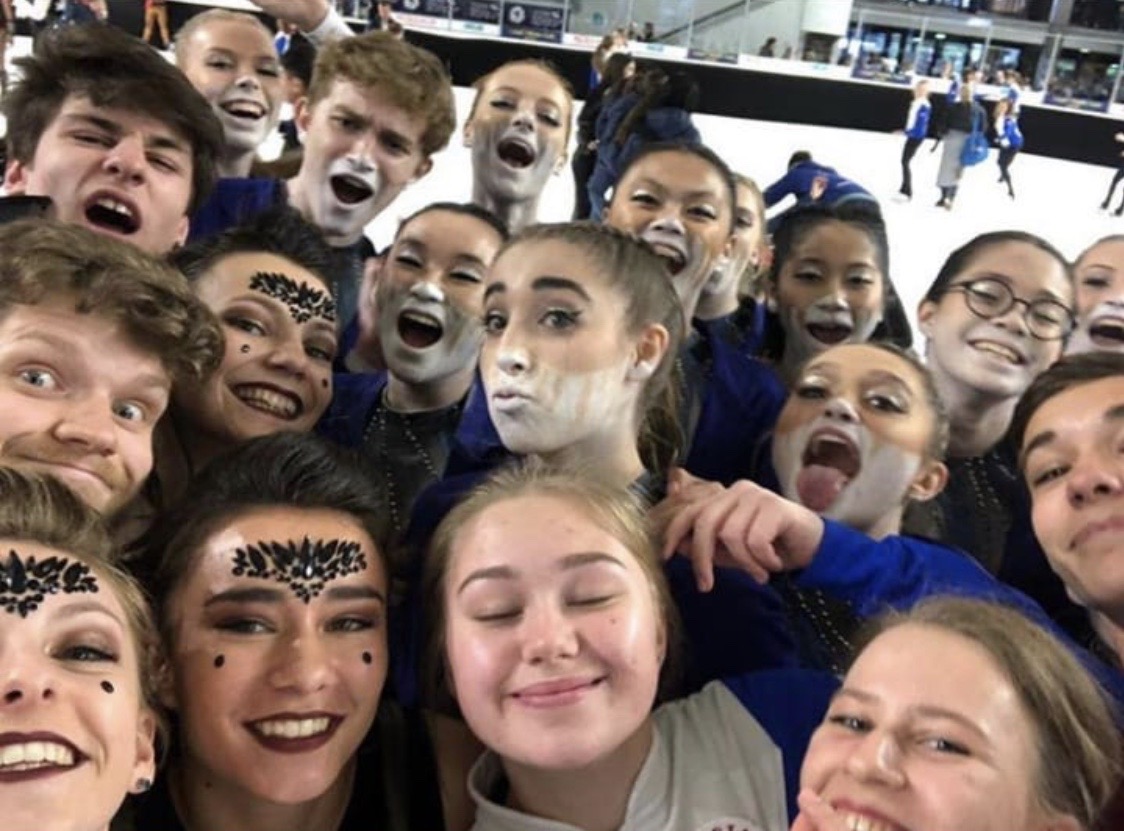
Along with ice dancing, you and your training mates also compete together in ballet on ice (also known as theatre on ice, or ballet sur glace) and this past April, you and your team won the senior division at the discipline's most prestigious international event, Nations Cup. What is your personal experience with competing in ballet on ice?

We are not as involved in ballet as other places. For us, it is a requirement for ice dancers. We won Nations Cup when we were training just one hour a week. It's the same as last year when we made our programs only one week before the first competition, so we don't train so much ballet.

I think the level of ballet is improving every year. At the last Nations Cup, it was really competitive and I really liked it. The atmosphere was really good between all of the teams, and the American teams had such spirit for the sport. It was a big pleasure to meet American teams this Nations Cup, because the result was closer than ever. All the time when Villard de Lans would win Nations Cup, they would win by many points. This year, it was closer than ever. We were at a really good level, and the American team (Silver medalists Forte of Boston) finished very, very close to us. It was a good competition and I hope it will be the same in the future, and maybe we can lose! We don't take ballet on ice as seriously as American teams might. I think American teams train a lot more than us. I think a team like Hartland (Harmony Theatre Company from Hartland, Michigan, one of America's top theatre on ice programs) trains a lot. I think one day they will beat us and it will become really normal.

A picture from Nations Cup that perfectly shows the joy of skaters from all over the world joining together in a supportive, friendly environment. - Photo courtesy of Solene Mazingue

What is it like to train in two disciplines at such a high level?

With ballet, it's not as high level as ice dancing. Right now, for example, it's been about two months since I've practiced ballet on ice.

How do you think ballet on ice influences your ice dancing?

I think it's a really good exercise for ice dancing. I learned to dance in ballet on ice because of the programs made by Karine. I was not a good dancer when I came to Villard de Lans, and the ballet has really helped me on that. I think it has helped me get the feeling and timing of the music.

I noticed that your Carmen free dance was adapted from your ballet free skate from Nations Cup.

Yeah, ballet on ice has really helped me with that.

The senior theatre team from Villard de Lans (Including Demougeot and Le Mercier, Dupayage and Nabais, Terreaux and Perron, and senior couple Lila-Maya Seclet Monchot and Renan Manceau) performing their Carmen free skate. See how much choreography you can find that was adapted for Demougeot and Le Mercier's free dance!

With all of your competitions for both disciplines, you must travel more than the average skater. How do you manage such a busy schedule?

The season of ballet is not during the same time as the season of dance, so it's okay for traveling. At the end of the season for ice dancing, we don't travel so much, because there is only the world championship. We travel for the world championship, and it's okay after. When we compete in ballet, it's either in France or for Nations Cup. We don't do competitions in other countries, except for Nations Cup.

It must not be easy to compete at the World Junior Championships one week and compete in ballet the next week.

Yes. Right when I'm done at the world championships, I don't want to do ballet, but once I'm competing, it's okay. At the start, it's hard, but after it's okay.

It's a lot of work to do what you do. What keeps you motivated to do everything you're doing?

For me, what motivates me is winning. I only do sports for winning. I don't like doing sports just for doing sports, you know, for improving, etc. When I train hard and I want to improve, it's for winning. It's the only reason I do sports. The gold medal is my motivation.

Loïcia and Théo in their Argentine Tango Rhythm Dance from last season. - Courtesy of Robin Ritoss and ice-dance.com

Quick Questions

What music do you listen to outside of the rink?

I listen to a lot of types of music. I like American rap and French rap. When I like music, it can be anything. I can like some French rap music and I can dislike some French rap music.

What is your dream song to skate to?

That's a difficult question. When I listen to music, in the moment I can say "I want to skate to this." When I like music like that, I listen to it a lot of times, so one week later, I'll say "I don't like this anymore." I don't think there's anything I really want to skate to right now.

What is your favorite place you've traveled to for skating?

I liked Richmond, because we went to Vancouver, and it was really good. I think Nations Cup in Ann Arbor (Michigan) was my favorite trip, even though I was sick. I had mononucleosis after the competition, so I couldn't go to Niagara Falls. I was a bit disappointed because of that. It was a good memory, not because of the mono, but the travel was a good memory. We went to Toronto, and I really liked it.

What is your favorite pattern dance?

I like the Blues. I think I'm strong in that dance. I like the Argentine Tango too.

What do you like to eat after practice?

I like to eat something like burgers or kebabs. I like junk food. It's not good but I like it. I try not to eat it a lot but I eat food like that sometimes. When I'm really hungry after training, I love to make a ham sandwich. I also love to drink fruit juice, so I normally have this when I'm hungry after training. This year, we finish our training at noon, so when I go home after, I can't eat the same thing anymore.

Théo will take the ice with Loïcia this week at the Junior Grand Prix Final starting this Friday. Good luck to them!

If you enjoyed this interview and would like to see similar posts, let me know who else I should interview. I've been looking to start doing posts like this for a while and I'd love to continue with this type of coverage.

Happy December!
-TJ