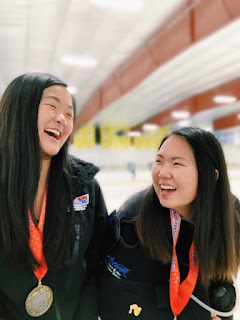
March was a month of great change in all of our lives last year, and we all have a unique way in which the COVID-19 pandemic has affected us personally. If you're a skating fan, you probably know that last year's World Figure Skating Championships, set to be held in Montreal, Canada, were cancelled. What you might not know, however, is that one week earlier, the final ISU championship event of the season, the World Junior Synchronized Skating Championships In Nottingham, Great Britain, took place as the world seemed to fall apart around the arena. What many people also might not now is that several of the teams planning to compete at this event ended up withdrawing. Both of the American teams, who had been practicing in Great Britain for several days leading up to the competition, were gathered into a small conference room in their hotel early one morning, where they were told that they would be withdrawing from the competition and flying home that same day. In minutes, the hopes of forty teenage girls to be among the top junior teams in the world were crushed, and for many of them, their skating careers ended in that very room.
Emilie Rennie, one of these skaters, competed for the Skyliners junior team, the first American team to ever receive a medal at the Junior World Championships. After two consecutive podium finishes at the competition, with silver in 2018 and a bronze in 2019, the team was looking for a new achievement, the gold medal. "Sky junior wanted to win worlds. That was the goal," said Emilie.
A resident of Lexington, Massachusetts, she began skating when she was in fourth grade. Her mom wanted her to participate in a sport after school, and skating was what Emilie chose. From there, she began skating at her local club, the Hayden Recreation Centre. Given that her club was the home of the country's most successful synchronized skating team in its history, the Haydenettes, it was only natural that she wanted to begin doing synchro. The introduction of the sport came from Emilie's coach, Erika Hoffman, a former Haydenette herself. "I didn't really like the idea of skating on the ice by myself, and so it definitely helped having teammates be there around me," Emilie noted.
From there, Emilie joined the Hayden synchronized skating program, and ever since she started, it was her dream to be a member of the Haydenettes someday. For seven seasons, she worked toward her lifelong goal and progressed through the ranks of the organization, winning two national championships at different levels. After her second season with the novice-level team, the I
ce Mates, Emilie was hoping to move up to the Lexettes, with whom she could compete in the junior division and compete internationally as a member of Team USA for the first time. Unfortunately, she didn't make the team. As a result, she skated with the Ice Mates, which was moved down to the intermediate level, for a third year, and won her second national title that season. At that point, she was satisfied, because she had a gold medal to mark not only the end of her season, but also the end of her competitive career. That was what she thought, at least.
While talking with a friend about how much she would miss skating, her friend suggested that she come with her to Connecticut the next day and tryout for the Skyliners junior team, a team representing the Skating Club of New York that had proven themselves to be the top American junior team in recent years.
"I don't have anything to do over the weekend. Yeah sure! I'll come tryout!" Emilie quickly responded. The next morning at 5 o'clock, she and her friend were on their way to Connecticut, and within 14 hours of deciding to come, she was on the ice, trying out for one of the top junior teams in the world. While many skaters put a lot of time and thought into a decision like this, she knew she had nothing to lose by showing up. Because of that, she, with the support from her parents, attended the tryout and took a second chance at becoming a member of Team USA.
Looking back on when she was offered a spot to skate with the nation's top junior team, Emilie struggled to identify a single emotion to properly encapsulate what she felt in that moment. The word she decided on was "awestruck."
Something she she had no trouble identifying,
however, was what this meant for her as a competitor. "It made me feel like I was worthy of being a skater, almost." As an athlete who's always been driven by the outcome, making the team made her feel as though her years of training had amounted to something big, and all the time she had put into her skating was not a waste of time. This goal-oriented mindset would continue to push her in the coming season. Going into her senior year of high school while training hours away from her hometown in her final year of synchronized skating, she knew a junior world medal would make it all worth it.
Once she began her senior year that fall, she would mostly attend her classes as any other student would. At noon of Fridays, she would leave school early in order to make the three hour drive to skate with the team in Connecticut, where she and her dad spent the night in a hotel. On Saturdays, she would take the car to make the forty-five minute to the next rink in New York. On Sundays, training ended back in Connecticut at 8 o'clock at night, after which Emilie and her dad would arrive home at about 11:30 or midnight, before getting six hours of sleep and starting the week all over again. Meetings with Emilie and her guidance counselor took place weekly in order for her to receive her work ahead of time and finish everything that needed to get done. While it was certainly a challenging schedule, she always knew why she was doing it. "It was definitely a sacrifice for the sport I love."
The challenges continued not just in the classroom, but also on the ice, as training on one of the best teams in the world was much more difficult than she had anticipated. Along with the caliber of the team being higher than what she had previously encountered, she also had to get used to a new method of coaching and a different skating style than what she was used to. Emilie describes this style as being fast and powerful, while also being very graceful.
Another new experience for her was her that fall was competing in the 2019 California Cup that November. Not only was she skating in her first international competition, in front of a home crowd full of American teams, but she also had the honor of competing in both the short program and the free skate, a privilege not many skaters in their first junior season get to have. "I definitely felt worthy of being a called a skater when I got to be put in both programs," Emilie said.
So how does she explain what it was like to continue to travel the world as a competitor for Team USA?
"Surreal."
She has fond memories of times while she was abroad when she wasn't skating, and she had the chance to walk around the area with her teammates and meet fellow competitors from countries such as Russia and Great Britain. Her standout experience, however, is when she and her teammate were chosen to carry the American flag at the draw ceremony at the 2020 French Cup, and pick their starting order for the next day's short program. It was in that moment when she realized just what it meant to skate for herself, her teammates, her organization, and her country internationally. "I was like, 'Wow, you are representing your country and you matter.'"
Going into the US Championships later that month, she would also feel what it meant to be a member of the junior team that everyone was chasing for a national title, and the team everyone would be talking about: "Sky Junior."
It was a very stressful competition, as the team had not made the larger point leads over other teams like they were hoping to throughout the season, but two strong skates at nationals allowed them to solidify their position as the top American junior team. It was a strong statement to make, as this was the team's final competition before traveling to Junior Worlds in a couple weeks.
Looking back at what winning her third national title was like, Emilie has a hard time recalling exactly how she felt. "It's honestly sometimes hard to remember. I think, not just for me but for many skaters, when you're just in that golden light ... that your memory's not always accurate," she said. While she does admit to being a perfectionist and feeling that there were things she could have done better, she felt that she was right where she wanted to be going into the final preparations for trying to get that junior world medal. "I'm not sure if that's the skate I wanted to be known for as like my last skate, but I think it was a great jumping off point for where we could have gone." she mentioned, and now that nationals was over, the team could focus on their big goal: becoming the junior world champions.
This is where things start to go bad.
It was in late February, after the annual Spring Cup competition in Italy (which Sky junior was not sent to compete at) when the team became aware of a virus beginning to slowly spread across the globe. Many of the team members did not think much of it, but the growing prevalence of the spread began to have a big effect on the team's training. The coaching team and the parents, many of whom work in the medical field, took action to keep the skaters safe. When one member of the team caught the flu, she was placed in isolation for the safety of the team. Temperature checks soon became mandatory at each practice, something that back in early March, would be an unthinkable thing to do during training.
Still, in the second week of March, the team traveled to Nottingham, fully intending to compete for a world medal. If they were afraid of anything, it was likely the possibility of not placing on the podium and not carrying on the reputation of the Skyliners like they were hoping to, whether it be because of COVID or not. What added extra pressure was the cancellation of the following week's World Figure Skating Championships in Montreal, as this meant that the teams competing in Great Britain would be some of the few to represent the US on the world stage. "We definitely were in for a surprise," Emilie said.
While it was a pressure-filled week, the team was doing well in
their practice sessions that week, and their coaches and team leaders felt that they were on track for a strong showing in the competition. However, the virus was not at all forgotten that week. When her roommate became sick, Emilie had to be moved to another hotel room in case her teammate was unable to compete. Skaters also had to get tested everyday when they entered the competition arena, a process that, for a full team of 20 skaters, was very time-consuming,
Then, former President Donald Trump's travel ban with continental Europe went into place. Emilie and her teammates happened to be awake late that night when news of the order broke. Once they saw that Great Britain was exempt, they thought they were still able to compete, so they were still determined to win.
7 am. A knock on Emilie's door.
When she opened the door and heard the phrase "You need to get downstairs now," she thought it was just a regular team meeting. She and her teammates quickly arrived at the meeting floor, still in their pajamas. Soon after that, the other American team, Teams Elite, arrived too, also in their pajamas. The skaters waited for approximately 20 more minutes, not having a clue what was going on. The US team leaders soon arrived, and everyone then entered a small conference room, one that did not have the seating capacity for all of the athletes, so many had to stand. Colette Nygren, one of the team leaders, began to address everyone. "She started off saying something like, 'we are so proud of you guys for everything that you've done,' and when she said those words, I remember starting to tear up." Emilie knew exactly what was happening.
In that moment, those 40 teenage girls were told that they would be withdrawing from the Junior World Championships. Their season had ended, and for several of them, including Emilie, they would never be able to compete at their final competition.
"I remember hearing one girl start crying, and we all just kind of cried along with her," she remembered.
What she also remembers is Colette hugging her, as well as telling the athletes "We will not judge you for what happens in this room." This was a shock to the skaters, as this highly-ranked official in US Figure Skating, who judged both teams in the recent national championships, was someone that these skaters were always expected to treat with respect. Still, Colette and the rest of the US officials knew what this meant to the athletes, so they gave the teams the chance to fully process what was happening to them.
Then, the skaters were told to go back to their rooms, pack their things, and be downstairs and ready to leave in 30 minutes. Emilie moved like lighting to get her belongings together, but in that short amount of time, she knew she needed to call someone very important to her: her coach, Erika.
"She's just been my life long supporter. She was the person that convinced me to do synchro." Erika told Emilie to pack her stuff and that she was so excited to see her back home. She also looked forward to discussing what the next steps for Emilie would be. "I always loved Erika because she always had a plan."
Not long after that, Emilie and her teammates were boarding a bus that would take them to the airport and back home. It seemed as though the skaters had gotten all of their tears out earlier that morning, so Emilie's trip back home was relatively unemotional. When she arrived at the airport in Boston, however, she started crying again.
It was a tragic end to her competitive skating career, and unfortunately, Emilie took it very hard. She tried her best to feel nothing, but when the pandemic forced her school and local rinks to close, sitting at home with the thought of what happened became unbearable to her. "I know it wasn't my fault, but I just felt like I had failed." Throughout the year, she had worked with a sports psychologist, Kelsey Griffiths, to ease the difficulties of her transition from Hayden to the Skyliners. In September of that season, they constructed a goal sheet, with the achievement at the top of the sheet being "World Medal." Emilie's season, in her mind, became defined by those two words. Those weekly car rides, grueling weekend practices, trips around the world, and periods of time away from school would all be worth it if the result were a prize hanging around her neck. When that was no longer a possibility, she felt as though her year of hard work was a waste. "I shouldn't have defined an entire year of work in an award."
Like many of us, who have had many events that were dear to our hearts get cancelled, Emilie seems to have learned that instead of depending on a single week to make her whole season worthwhile, it is much better to find joy in every step of the way toward her goal.
Coming off of her end to the season, she had a very difficult time truly enjoying the sport she had spent so much of her life doing. As she spent so much of her time on the ice preparing for upcoming competitions, she lost sight of what it meant to have a connection between herself and the ice and just skate. "I'm still working on this, but I'm hoping to get it back."
Something that's brought her a lot of happiness on the ice is skating outdoors with her former teammates at a small outdoor rink in the Boston area. She's had to wait up to an hour and a half in line in freezing temperatures to get a spot on the ice, and the sessions would be packed with recreational skaters, but for Emilie, it was perfect. "I think I'm enjoying the skating part of skating a lot more now, but I think it's gonna take a while to be not to be not totally obseessed with what could've been in my competitive season."
For Emilie, everything is a step toward loving the sport again. As a current freshman at Northeastern University, she had the chance to attend a Zoom meeting with Gracie Gold through the university's figure skating club. Knowing the struggles Gracie has had with mental illness and disordered eating, Emilie asked an important question to the one person who could answer it best: "How do you repair a toxic relationship with skating?" What Gracie told her is that she has to want it, and she needs to figure out where her problem with coming back is stemming from. In Emilie's case, it was her need to win. This drive is what pushed her to continue skating, instead of a love for the sport. Instead of progressing because she wanted to skate, she went on because she felt she had to. Now, with nothing left to win, she has the chance to skate for the sole purpose of loving it. "It's nice knowing I can stop anytime I want to, and yet, I won't."
This doesn't mean that she's done with the competitive aspect of skating, however. Because of the judges who traveled with her to Junior Worlds, she felt inspired by the supportive role they filled for the athletes in such a difficult situation. Now, Emilie is looking to become a judge too, and she's currently in the process of being able to judge both synchro and ice dancing. She's also been looking forward to the idea of coaching other skaters, as well as working to develop synchronized skating in new countries, as the sport does not have the level of international representation that other skating disciplines do. She hopes that efforts such as this to make synchro more well known globally will push the sport toward inclusion in the Olympic Winter Games.
Still, her current relationship with skating is the product of an active and continuous fight. With three national titles and two international medals to her name, she's very proud of herself, but even after everything she's done, there's still a part of her that feels like it wasn't enough. There is one thing she hopes to do to find some degree of closure however: have one final skate in Nottingham, at the arena where she could have achieved her season-long dream. Deep down, she knows that she'll make it there one day. "I'm very driven and I will get there. I will go back."
Each of us has a story to tell about how the COVID-19 pandemic has impacted our lives. Emilie's story is one that I've been looking to share for a while, and I'm so glad she was willing to discuss her experiences with me! She's an incredibly kind and determined person, and it was a pleasure to learn so much about her as an athlete and a person. This piece is the first of a series I'm looking to continue with that I'm calling Competitors of COVID, where I talk about the unique ways skaters have been affected by the pandemic. I can't wait to learn more about people like Emilie and share what they've been through with others!
Stay Safe!
-TJ