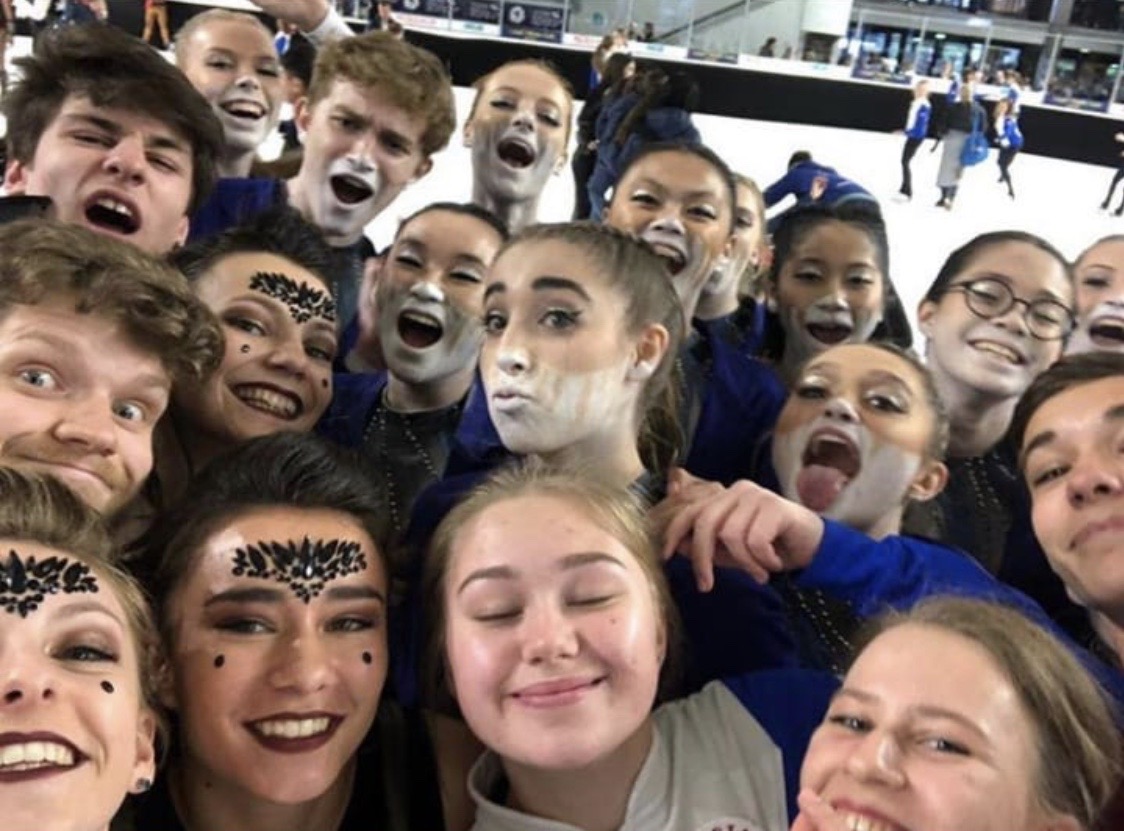
The inner workings of a 23 year old's mind who's been skating his whole life. Throughout all of the happiness and disappointment, the love for the sport still sticks!
Hello and welcome to Dutch to Golden, a figure skating blog to satisfy astonishingly few of your skating news, analysis, and recap needs. I'm TJ Carey, and I'm someone with a lifelong love for figure skating, practicing, watching, and discussing, so let's delve deep into what's up with our interviewees this week.
I've posted several interviews with competitive skaters here before, where I've shared the stories that haven't made their way to an audience in a competitive arena, but lately, I've been looking to learn about and share the story of a couple people with a different role in the skating world. While I always enjoy uncovering the stories behind a skater, this time, I decided to uncover the story behind a voice, or more accurately, voices.
Mary (right) and Alicia (left) attending the 2019 Autumn Classic International
Alicia and Mary Mirtsos are a pair of sisters residing in the Toronto area who have been skating since they were both children, and their love for the sport stuck with them as they grew up to be huge fans of the sport. Their shared passion for skating is part of what led them to create their own podcast, Flutzes and Waxels, where they discuss the results and performances of recent elite competitions. They use their personal experience in training as skaters to provide insightful commentary on each skater. Their deep understanding of the development of elite athletes and the scoring used to evaluate them, as well as the close bond they share as siblings, always makes for an informative and entertaining episode, for both new and old fans of the sport.
Their journey in the sport began when their mother, a teacher in physical education and math, began taking Mary, the oldest daughter of the two, to a recreation center take part in different sports like swimming and soccer. This rec center was also the location of the Mariposa School of Skating, an organization in Barrie, Ontario that was the home of some of the world's best figure skaters. Even with the high caliber of training featured at that rink, passing spectators were lucky enough to be allowed to watch practice sessions, meaning someone like Mary could see high-level skating in person for the first time in her life.
"That's the beautiful thing about Mariposa, compared to places like the [Cricket Skating and Curling] club and the Granite Club in Toronto now, or even Ice Galaxy. They are a little bit more open, but for the most part, those sessions are pretty locked down. You don't have people just wandering through, but if the Mariposa was locked down like that, we would've never become skaters." Alicia added.
Mary in her early years of skating
From there, Mary began to learn to skate at the age of two. As her mother brought her to her first session, she strapped her into a pair of bob skates, which are platforms with two blades on the bottom that are tied to a young skater's shoes as a more stable alternative to traditional blades. Seeing that these were not the kind of skates she saw the other figure skaters wearing, young Mary began to throw a tantrum, saying "These aren't real skates! I want real skates!" This, Alicia believes, was the beginning of a hobby that both sisters would take very seriously throughout their lives. This quality of becoming fully invested in an interest and putting all of their effort into is something that the sisters believe is a big part of who they are as people.
"We don't really do much by half measures. If we're interested in something, we'll go whole-hog and spend way too many hours on a figure skating podcast," Mary noted.
That was the beginning of Mary's dedicated path to figure skating, and as she grew up going to the rink and watching competitions on TV, it was no surprise that Alicia would watch along and take an interest in the sport too. She took her first steps on the ice at the age of 3, and soon enough, her interest in the sport became just as deep as her sister's. She and Mary continued to go to the rink as a hobby while also becoming fans of the sport, taking every chance they could to see their skating idols. Growing up in the 1990s, at the time of figure skating's booming popularity across North America, competitions and professional shows were broadcasted in great numbers to Canadian TV audiences. With all this skating on the TV, it meant young Mary and Alicia could watch their favorite skaters, tape them on VHS, and watch them over and over until suddenly, the Michelle Kwan Mulan On Ice special snaps.
Mary (left) and Alicia (right) in their childhood
That was the unfortunate case for Alicia, but for Mary, she recalls being particularly interested in watching the Canadian dance couple of Shae-Lynn Bourne and Victor Kraatz. As Mary wasn't a fan of doing jumps, Bourne and Kraatz became her vision of what she would want to pursue in skating. "If I were to consider, you know, going somewhere with this, ice dance was always the route ... I remember watching them on TV and thinking 'Oh, that. That's what I want to do.'" A few years later, Alicia took a similar interest in Marie-France Dubreuil and Patrice Lauzon, the successors to the Canadian dance throne. These teams became the sparks of the sisters' love for ice dancing that throughout their lives, they have never lost.
Currently, the sisters display their vast knowledge and great fondness for ice dancing, along with the other competitive disciplines, on their podcast, after each competition wraps up. Their deep understanding of ice dancing allows them to explain the complicated rules, mechanics, and scoring controversies to fans who are less familiar with the event. If there are viewers who need help understanding and recognizing the different options couples have for choreographic elements to perform, Alicia and Mary have a video on their YouTube channel to help. If someone needs a step by step explanation as to what happened on Papadakis and Cizeron's one foot sequence at the European Championships, there's a podcast episode waiting for them that covers everything they need.
Of course, with all of this knowledge of the regulations and mechanics of the sport, it's no surprise that while these two love to watch ice dancing, they are sticklers, or as they them to call themselves, "The Mean Judges." When watching the required pattern dance section of a team's rhythm dance, Alicia and Mary will be quick to call out when a cross-roll is performed more like a cross step, a key point is scratchy, or an untraditional free leg is not their favorite. Some might wonder why it is that they tend to critique teams with such a high standard. If one person where to be assigned the responsibility, it would probably be their former dance coach, Scott Chalmers.
While they first knew him as a coach for CanSkate, Skate Canada's introductory skating program, Scott was always especially passionate about coaching higher level ice dancing, and teaching skaters exactly how to execute their turns and steps correctly. He was a strict coach, but as tough as he was during lessons, he was still a kind person to the sisters as well as his other students. "It really came from a place of love and respect for the sport of ice dance, and so he was very particular about how you executed turns. it wasn't just about getting the edges correct," Alicia explained.
Alicia, along with Mary, quickly developed a desire for perfection from a young age.
Scott also had the philosophy of having his students work on their skating until it was perfect, instead of simply reaching a level that was sufficient for passing a test. He would work to have skaters be so prepared for their tests that failing would be nearly impossible. This approach was something the sisters greatly admired, and one that they struggled to find while working with other coaches later in their lives. "I did fail a few [tests] when I wasn't working with Scott. I never failed a single test when I was working with him, because he would say 'No, you are not ready. You're not testing it,'" Mary noted. Even after passing a test, Scott would have his students correct the errors they made on their previous test. The sisters believe that this mindset is a big part of what made them who they are now.
Mary had even taken from Scott in her short-lived partnership with the only boy at their local rink. She had considered committing to the competitive track as a teenager, but the sacrifices her family would've had to make made that too difficult. She doesn't really regret this, as she and Alicia much preferred the day-to-day process of training and practicing over actually competing. The opportunity to learn and improve on each session was the foundation of their relationship with the ice.
In 2017, the sisters began a new part of their relationship to skating: their podcast.
Frustrated with the "surface-level" skating coverage they'd seen in the media that normally discussed just the top finishers at big events, the sisters thought were was something missing, something more comprehensive, that should exist. Now living together as adults, Alicia and Mary found themselves having a weekly in-depth conversation about whatever competition had just ended, and through these conversations, they found what they were looking for in figure skating media. "Because we had felt that frustration about the thing that we felt like was missing, we decided that 'Well, we might as well try to fill the gap,'" Alicia said. They were inspired by a film podcast called Linoleum Knife, hosted by two husbands who essentially add a couple microphones to a conversation they were already going to have with each other.
With Alicia having an understanding of how to start a podcast from studying media in college, as well as Mary having friends working in music who she could borrow recording equipment from, the two were set up for an inexpensive start to their new project.
Something that the two sisters have discovered overtime while creating episodes is that even with the two microphones placed in front of them, it's easy to feel like they don't need to put on a performance for anyone. This is not only because of the absence of a video format, and therefore a camera, but also that the conversations they have for their podcast feel just like the conversations they would have outside of the show. "It doesn't feel as much like a performance, like you're putting on a persona for other people, because it's easy to just forget that 'Oh no, I'm just sitting here chatting,'" Mary noted.
The sisters are now creating episodes for a fifth consecutive figure skating season, and even as they've gained an audience over time, it still feels as though they're recording episodes for a small handful of listeners. Of course, they understand what it means to provide criticism for young athletes, and as a result, they do their best to provide commentary that is both positive and constructive. "We created this show talking about juniors first, thinking about how we wanted to talk about skating in a way that, if it was something I wouldn't say to a kid's parents, I'm not going to say it on the air," said Alicia. They have received messages, all very positive, over the years from skaters who they've talked about on the show, but every time they get a direct message on Instagram from a blue check-marked account, their hearts sink as they wonder if they crossed the line and upset a skater.
The first response they got from a skater, however, is one they will never forget. A junior ice dancer, who had been featured on the podcast, reached out to Alicia and Mary, thanking them for being so positive in their reviews. This was a big reminder of what kind of impact this show can have on the young athletes being discussed. "We're giving our honest opinions, and to hear that that meant something to somebody, it's nice to hear. It's like we're putting a little bit of an impact, however small."
It's a tough balance. While they both try to be as encouraging as possible for the skaters, they're still "The Mean Judges." What connects their encouraging attitudes and their high standards of quality is their consistent desire for skaters to be the best they can be, just like their former coach, Chalmers. It's this same desire for the well being and success for the athletes that has made them so vocal about safety in the midst of the COVID-19 pandemic, and while they did receive some criticism for speaking in depth about what could have been done to better protect athletes, they still felt a respnosibility to advocate for the health of everyone involved in recent competitions.
Having a deep appreciation for all skaters in an event is something that Alicia and Mary would like to share with their listeners. With primetime television coverage often only showing the top skaters in an event, it is difficult to become fully invested in the careers of skaters who are rarely shown in these segments. With a more comprehensive format designed to see both a skater's strengths and their opportunities for improvements, the sisters hope that their show will encourage viewers to root for more skaters than just those at the top. "The sport is better for it if you can appreciate more than just the top few skaters, and I really think you are better for it when you can appreciate more than just the top couple of skaters," said Alicia. "There is nothing that gets us more excited than seeing a junior, especially ice dance team, I mean that's our soft spot and I think everybody knows that at this point, but to see a junior dance team and say 'Yeah, that maybe wasn't a great set of skates, but look at this thing that you've got.'" All in all, their goal is simple, to leave figure skating better than they found it.
The sisters' shared love for skating has taken them many places together, including the Lake Placid JGP in 2019 with their mother!
I had thought about ending the interview at this point, but through talking about their upbringings in the sport, their skating idols growing up, and the beginning of their podcasting endeavors, there was one crucial question I knew I needed an answer to. What lead Mary and Alicia to pursue their interest in the sport together, instead of separately, after all these years?
"I think the biggest thing is that we have always been fairly close. Everybody I talk to who finds out that I have a podcast with my sister goes 'I could never do that with my sibling!' and there was absolutely a period in time when we were teenagers where I would've said the same thing, but we've always been fairly close. We've always been quite a lot alike. and we also both quite like structure in our lives, quite a lot, so this gives us a place to have the time to spend together that's kind of non-negotiable at this point," Alicia explained.
Recording episodes for the podcast acts as a routine way for the sisters to spend time with each other, and it's this structured activity that makes it easier for them to connect, especially after a long day of work. "We both work 9 to 5's, and whether it's like now, when we're in separate rooms on our laptops for COVID times, or often different parts of the city at the job, when you get home from work and you're exhausted and you just want to eat dinner, lie in bed, and watch something on your laptop, this is a good excuse to say 'No, we're gonna hang out right now and talk about skating,'" Mary said.
It's their shared interest in skating that may have also kept them from drifting apart earlier in life. When Alicia moved away from home to go to college, she was still able to bond with her older sister over the ongoing Winter Olympic Games in Sochi. "It was really nice," Alicia said, "to have that thing to bond over where we didn't know anybody else who cared nearly as much as we did."
Alicia and Mary were an absolute pleasure to talk to. It felt like I had my own exclusive episode to listen to! The way they bounced back and forth between each other for responses is very reminiscent of how they speak on the show, and it really shows just how close they are. You can find their weekly recap episodes of major skating competitions at Flutzes and Waxels Podcast, wherever you get your podcasts. To keep up with them on social media, get in contact with them, or access bonus content and merchandise, here's where you can find them:
The 2019-20 season in figure skating has officially come to an abrupt end, and even though this is a season that did not conclude in the greatest of circumstances, I'd like to look back at something I found particularly interesting this season: the introduction of the Tea-Time Foxtrot as a competitive pattern dance. This dance, the required pattern every junior couple had to execute during their rhythm dance, was expected to be quite the challenge, as it features many difficult turns for each partner and unusual partnering that a couple with limited experience may struggle with. It's a dance that my coaches have actually described as more of a step sequence than a pattern, partly because it is much more compact than some other dances in which the couple seems to fly down the length of the ice. Considering this dance was essentially created as a step sequence, this makes a whole lot of sense.
So, while I have the time, I thought I would take a look at how teams faired with this dance. I looked back at the scores and levels (for both sections of the dance) for every team who competed at a Junior Grand Prix event, the Youth Olympic Games, or the Junior World Championships. I'd like to see if there's a difference between how well each team did in the first half of the dance (Section 1) and the second (Section 2). I also want to see how often teams are getting each level, and the grades of execution that are being awarded to them from the judging panel. Let's see how the teams did this year with the pattern.
Background
Pattern dances are a staple in the testing and competitive structure of ice dancing, and have been a requirement for junior and senior couples to do within their short dance (now called the rhythm dance) since the 2010-11 season. After the 2014 Olympic season, a new element was introduced to the senior short dance, this being the partial step sequence. In this element, couples would essentially create their own pattern dance, staying in hold and traveling counter clockwise around the ice. While in the first season, levels for this element were based on the execution of repeated steps from the required paso doble pattern, the rules changed for the 2015-16 season so that levels would be determined largely by the execution of difficult turns and steps, choreographed by the couple. This meant that couples had nearly complete freedom to put together their own steps for this element.
That season, Natalia Kaliszek and Maksym Spodyriev of Poland performed their partial step sequence to a foxtrot rhythm, and the ISU liked it so much that they decided to make it a pattern dance that all couples would be able to do. This dance, of course, is the Tea-Time Foxtrot. This is one of three new dances the ISU recently decided to introduce, the others being Piper Gilles and Paul Poirier's Maple Leaf March from the same season and Jayne Torvill and Christopher Dean's Rhumba D'Amour from the 1993-94 season. Initially, the plan was to introduce all three of these dances at some point during the four seasons leading up to the 2022 Olympic Games, but given that the patterns from this past season are now being reused for the 2020-21 season, it's unclear how soon we'll be seeing these other dances.
Even though the Tea-Time was created for a senior team that placed 14th in the short at the 2016 World Championships, this dance was required for all junior couples to perform. This is because Kaliszek and Spodyriev are still competing, and making this dance a requirement at the senior level would obviously give them an unfair advantage. As a result, this dance became a real challenge for the juniors. There are several couples who struggled to maintain the timing of the dance, potentially finishing the pattern two to four beats later than they should, or even more. Also, given the nuanced nature of the dance's timing, it's very difficult to tell when to pick up the dance after a timing issue or an interruption, leading to even more issues with timing. While this certainly wasn't the case for every couple, it wasn't a walk in the park for anyone. Here's how it went down.
Level 4s
There were 14 couples who received a level 4 for the first section (essentially the first half) of the Tea-Time. Their scores are compared here to the benchmark values for grade of execution. For example, a score of 6.55 means the couple got an average GOE mark of +2.
For the second section, only three couples received a level 4, each of them only achieving it once.
81 couples competed across the entire Junior Grand Prix series, the Youth Olympics, and the Junior World Championships this past season. Altogether, that's 170 performances of the Rhythm Dance. Across these competitions, a level 4 was achieved in the first Section of the dance by 14 couples, an overall total of 17 times. The three couples to get a level 4 twice during the season were Elizaveta Shanaeva and Devid Naryzhnyy, Avonley Nguyen and Vadym Kolesnik, and Diana Davis and Gleb Smolkin. In the second Section, only three teams achieved a level 4, each of them achieving it only once. Just two teams, Shanaeva and Naryzhnyy and Katarina Wolfkostin and Jeffrey Chen, received a level 4 for both Sections in the same performance.
The scores of all the level 4 Sections range from 6.78 to 5.65, with all of them receiving positive grades of execution. Nguyen and Kolesnik have the highest-scored section out of these couples, achieving it in Section 1 of the of the pattern at Junior Worlds. Five judges gave them a +2 for GOE, while the other four judges gave them +3s. The highest score for Section 2, 6.70, was achieved by both Nguyen and Kolesnik, at JGP Baltic Cup in Poland, and Shanaeva and Naryzhnyy at Junior Worlds. In both cases, the couples received three +3s, five +2s, and a +1 from the judges.
Out of the 81 junior couples competing in a major international, only 14 received a level 4 on the first Section, or approximately 17.3%, and no couple achieved it more than twice. The 3 couples that executed a level 4 Section 2 make up only 3.7% of the teams. If we base these percentages off of the 170 performances instead of the couples, we would see that a level 4 Section 1 was achieved 10% of the time, while for Section 2, it is only about 1.8%.
What's interesting to note about these scores is how they compare to the scores of couples who received a lower level. For example, the highest score received by a team for a level 3 Section 1 was 5.80, which was achieved by Wolfkostin and Chen, Sofya Tyutyunina and Alexander Shustitskiy, and Loïcia Demougeot and Théo Le Mercier. Out of all 14 couples who got a level 4 throughout the season, only one received a lower score than 5.80. Another couple, Ekaterina Katashinskaia and Alexandr Vaskovich, got a level 4 with a score equal to the highest level 3 score, with a base value of 5.50 and an added GOE score of 0.30. The couples with the highest score for a level 3 all got a base value of 4.75, with an added GOE of 1.05, or an average of +2s from the judges. What this all means is that even though the judging panel thought the sections performed by the couples who got a level 3 were executed better, Katashinskaia and Vaskovich were able to score equally as well by doing all of their key points correctly.
I think this is an example of the imperfections of the current system of evaluation. While the judging panel evaluates the entire pattern and watches for factors like edge depth, effortlessness, flow, holds, and unison, the technical panel evaluates whether or not small sections of steps and turns, these being key points, are executed correctly. As far as the impact on a couple's score, it seems that the key points, and therefore the level, are the biggest deciding factor. While I definitely don't mean to say "This couple should have scored higher than this other couple," I'd like to see the strength of the entire section of the pattern have more of an impact on the score for the element.
Spread of Levels
While looking at the teams who received level 4s, we could see there was a big difference in the number of times they achieved it in Section 1 and Section 2. However, there's also a similar drop for the number of times a team got a level 3. This drop goes from 33 times to 19. What I think is especially interesting is that there is a rather large increase of times a team received a level 2 on Section 2, compared to Section 1. This jump goes from 45 to 71, enough times for almost all 81 couples to receive a level 2 once. From this, we can tell that for the most part, teams had a harder time with the second half of the dance than the first, and with the requirements that have to be met to achieve a high level in the second half, this is not too surprising.
Essentially, the level of a section is determined by the correct or incorrect execution of four predetermined sequences of steps or turns. These are the "key points" the technical panel looks for. For the second section of the Tea-Time, the third key point is the lady's outside bracket. The fourth is the bracket the man does at the same time as the lady, along with his crossover, change of edge, and twizzle. These are arguably the two most difficult key points in the entire pattern, and if neither of the partners in a couple get their bracket called, their second section can not be given more than a level 2. By looking at the protocols from each of these competitions throughout the season, it's clear that the bracket was generally what kept teams from getting a higher level on the second section. In fact, out of the 18 couples who competed at the Junior Grand Prix de Courchevel in France, there was not a single skater who got their bracket called, meaning no couple got higher than a level 2. When comparing this to the levels received for the first section, where levels were somewhat fairly spread out from 1 to 4, the downward shift is obvious.
Comparing the rather evenly distributed spread of level for Section 1 to Section 2 shows a clear difference in how each half was evaluated across the whole event.
Comparing Levels By Couple
Another way to compare the execution of each section is to look at what each team got for levels within the same performance. To do this, We can subtract the level a couple gets for Section 2 by their level for Section 1 and use the result to determine the change. For example, at the Junior Grand Prix Lake Placid in the US, Nguyen and Kolesnik received a level 4 for the first section and a level 2 for the second. If we take their Section 2 level, a 2, and subtract their Section 1 level, a 4, we would have the result of -2. This means that Nguyen and Kolesnik dropped two levels from their first section to their second. Naturally, a positive result would mean that a couple improved their level between sections, and a zero means that there was no change in what their level was. For the purpose of this comparison, a Base level is considered a zero and a no value section is a negative one.
For the most part, each couple had better success with their first section than their second. On average, each team had a drop of about .218 levels within each performance. However, there were still a couple competitions where couples, on average, had a higher level for their second section, which were JGP Lake Placid, JGP Chelyabinsk in Russia, JGP Baltic Cup, and the JGP Final. It should be noted that at two of these events, in Lake Placid and Gdansk, there was one couple at each event who had an uncharacteristic fall in the first section that brought their level down to a base, even though they each received enough key points to get a level 1 or 2.
I also looked at the average change in levels for each couple across the season. Out of all 81 couples, only 38 decreased on average within the program. 21 couples generally had a stronger second section than their first, and the 22 remaining couples received levels that, on average, stayed the same. The greatest increase between each half of the dance was 2 levels, achieved by Anya Lavrova and Maxwell Gart as well as Ayumi Takanami and Yoshimitsu Ikeda. However, each of these couples only competed at one major international this season. 2 other couples, Svetlana Lizunova and Alexander Vakhnov as well as Angelina Lazareva and Maksim Prokofiev, had an average drop of 3 levels from their first sections to their second. Like Lavrova and Gart and Takanami and Ikeda, these couples only competed at one major international.
Whether it be an average increase or decrease throughout the season, most couples did not have a dramatic shift from their first section to their second. There were only 10 couples in total who had an average shift of more than one level. This means that whatever level a team got for the first section, their second section usually got a similar level, and while many teams tended to have a stronger first section than their second, it was not by an overwhelming margin.
That's essentially what I have to say! I originally had a whole lot of information on this pattern that I put together and I'm glad I could condense most of it into a much more graspable summary. What are your thoughts? Do you have a strong opinion on the evaluation of key points in relation to the whole pattern? Do you think the key points for this dance are fair for the junior level? Let me know in the comments! Wishing all the best to you and your loved ones, -TJ
With the three-time Canadian Junior Dance Champions and 2019 World Junior Champions, Marjorie Lajoie and Zachary Lagha, moving up to the senior ranks last season, the scene of junior dance in Canada was sure to go under a big change. With three other top five couples in the country either moving up to senior as well or splitting up, many of the top spots in the country were wide open. As a result, four couples established themselves as the top couples in the nation, and to maintain a lead over each other was no easy task.
One of these teams, Nadiia Bashynska and Peter Beaumont, showed tremendous improvement coming out of their debut junior season and achieved immediate success, winning the 2019 Lake Placid Ice Dance International and being the only skaters representing a country other than Russia to earn a medal, bronze, at the Junior Grand Prix event in Chelyabinsk, Russia. The couple trains outside of Toronto, under the coaching team of Carol and Jon Lane, Juris Razgulajevs, and Marc-André Servant. There they get the opportunity to train alongside several couples ranging from novice to senior, including Piper Gilles and Paul Poirier as well as Molly Lanaghan and Dmitre Razgulajevs.
I had the pleasure of sitting down and talking to Nadiia and Peter about the origin of their partnership, their development as a couple, and more. They're two incredibly kind people and conducting this interview was a great way to distract myself from everything going on in the world right now. I hope this can help you do the same!
*Responses have been edited for clarity.
Photo courtesy of Daphne Backman and Ice-dance.com
How did you each start skating?
N: I think I started skating because I was sick when I was younger, so my mom put me in figure skating to get better. Then, when I got older, when I was like 5, I kind of started liking performing and the feeling of competing and placing, although I never placed, but when it happened it was really nice, so I kind of stuck to it. I was doing singles skating at first, when I was younger. Then I moved to ice dance because I hated jumping, pretty much. That's just the way it is, and I kind of don't remember doing anything else except skating.
P: When I started skating, I was actually quite a late bloomer to it, so I started skating when I was 8. At first I was into athletics, so I was doing multiple sports like track and field, all that sort. The teacher for the class on one of the mornings wasn't in, and across the road there was an ice rink, so one of the receptionists said "Oh, we'll take all the classes and go skating for an hour instead of doing athletics." That's how it all started. I started in the Skate UK program, which I think still is in the UK now, gradually went my way up, and decided that that was what I wanted to do.
How did your partnership begin?
N: It was a really long process, actually. I found Peter through Ice Partner Search. It's actually a really helpful app. I found him through that and we kind of emailed him. (Looking to Peter) I don't think you ever replied to our email. (laughs)
P: I broke up with my partner not as recently as you had, so you were looking for a partner a bit longer than I was.
N: I was looking for a partner for a whole year, so I didn't know if I was going to still skate.
P: I was looking for a partner for about 4 months, and I was at the British Championships that year, which I was supposed to be competing at, but obviously I didn't. Our coach Jon was there at the British Championships with another team that he had, and he obviously mentioned Nadiia. The next year, from November to January, that January I went to a tryout, skated, and that was that.
N: I had tried out with a few guys before, and when Peter came, on the first session I was like "Wow, it's never felt so good before." It just felt like it was the right thing.
P: She's just being nice now. (laughs)
N: No no no! No, I've told you several times, it was just really cool and I had never felt that before. Right away, it was a good partnership.
P: We were saying how quick it was. I had split up with my partner that November, and I had started skating with Nadiia in January, but then we really started properly training in June, because I had my English exams, and once I had finished those, two days after my final exam, that was that, I moved over. I've been here ever since.
N: Yeah, it's been really fast.
So Nadiia, you had already been in Ontario?
N: Yeah, I had been in Canada before Peter moved for one and a half years. Almost two when he moved here, so skating with me it was almost two years. At that point before I met Peter I was seriously deciding to quit and go to ballet as another thing I was going to do, but because Peter came and it was really good, I stuck to skating.
Photo Courtesy of Daphne Backman and Ice-dance.com
You were both born in different countries, Ukraine and Great Britain, yet you're representing Canada, a country that from what I've heard, neither of you are citizens of.
P: Nope.
N: Nope.
P: You were supposed to get your citizenship.
N: Yeah, I was supposed to get it on the 31st of March, but because of COVID-19, I can't. It's cancelled, probably postponed until May, or June, or whatever, like when it's going to get better. Then, I'm going to be a Canadian citizen, but Peter is only trying to get his permanent residency.
P: I've applied for residency, so hopefully that shouldn't take quite as much time.
So how did you end up choosing to represent Canada?
N: Mainly, I think you moved because of me, and I moved because of the lifestyle. If you look into Ukraine and the history of all the skaters, there's a lot of good skaters that moved away to different countries. It's sad, but there's not a lot of potential, like these countries like Canada, America, Germany, other countries, you have a little bit more potential, in terms of funding...
P: It's like Aljona [Savchenko], right? She's Ukranian.
N: Yeah, and a lot of other teams right now, like my friends, have moved to all other countries.
P: Avonley's partner Vadym [referring to Avonley Nguyen and Vadym Kolesnik] is Ukrainian.
N: Vadym! He was my best friend when I was younger, and we knew each other so well. Well, we still do, but we don't talk as much. Things changed.
P: But you were moving countries.
N: Yeah, and now he's in America, I'm in Canada. Things do change a lot.
P: And with me and the UK, the federation has been changed recently, not to my knowing, but through people telling me. It was called NISA, National Ice Skating Association, which got copyrighted for a food store in the UK, which isn't as big as Walmart or whatever you want to call a grocery store. So they had to change the name of it, because nobody had really heard of it, and they changed it to British Ice Skating, which made more sense.
The federation before was, to put it this way, they'd give you options for Grand Prixs and then you'd be a bit more like "Are we going to be able to this or aren't we going to be able to do it?" you know? We decided that Skate Canada, for us, worked better. You know, we're in the country, there's more opportunities for us here so, yeah, we decided to take that.
N: Yeah, I moved to Canada purely because my dad just didn't want to stay in Ukraine, purely because of a lot of different things that happened to my family in Ukraine. It was definitely a lifestyle change. This still feels like a dream. It's not real. It's so different to Ukraine and what I grew up in, but it was a good change, and Canada has good skating.
P: Yeah it's a big federation in skating. And especially when we decided to start skating together, there's Tessa and Scott, which were favorites for worlds and stuff.
N: Piper and Paul.
P: Piper and Paul were good as well. There's been a lot of Canadian teams that have been high-ranked in the world, so that was the main place for us, Skate Canada.
In your first season together, you competed at the novice level, winning the national championships. How did your success compare to your expectations for that season?
P: Well, we talked about it before, actually. At the beginning of the season, our coaches sat down with us. We were a really new team at that time and Carol said to us "We want you to win the national championships." You can probably imagine our expressions to each other. We were like "Okay, that's a bit of something new for us there," and until our first competition we had no idea what to expect.
N: I fell in our first competition. I forgot about that. (laughs)
P: Even with that fall, we still managed to win that competition, which was our first competition as a team together, so that really put us on a but of a pedestal, being, "Yes, we can do this," and throughout the season we went through with that mindset. I think we came second in only one competition that season.
N: Challenge.
P: Yeah, we were really blown away with how that season went.
N: It was really a good season for us.
P: To win nationals and prove our coaches right, that was something else, as well.
N: We won nationals in six or seven months skating together, and I thought that was crazy, honestly. The amount of skating experience that happened with my old partners, before we actually won anything, it was like two years. And with you in like seven months, Boom! Nationals. Done.
P: We started training in the end of June of 2017, and nationals was in January 2018. They moved it forward because it was the Olympic year. This is all in the context where we were still finding each other out, how each other skated.
N: How we both work.
P: How we work together, because was it your first year at the novice level, like advanced novice?
N: Yeah, I went from basic novice internationally to novice.
P: And I went from skating in the UK junior level going back down to advanced novice, so it's a bit of a "Let's meet in the middle. Let's do novice,"situation. It was a good season for us.
N: I mean Junior in Canada is crazy. Our first year in junior was nuts. Scary stuff.
The following year, your junior debut, your Cinderella free dance featured a costume change in the middle of your character step sequence, a brand new element at the time. How did that become a part of the program?
N: [The costume change] was so stressful. (laughs) So stressful, honestly. I don't know who came up with the idea of a costume change. I think it was like a rink idea, and our coach Carol Lane was like "Oh my God, we're definitely doing this. That's it."
P: It was just a thing that went around the rink, I think.
N: Yeah, so it was a really good idea, actually. A lot of people remember us for the costume change, which is great. Stand out with something, you know?
P: Well, first year team.
N: First year team, obviously. You want to be remembered for something, and we had a costume change. It was definitely a stressful thing, but it was really fun. You kind of miss it, you know, having different costumes.
Nadiia and Peter's Cinderella Free Dance from their junior debut and Canadian Nationals. If you want to make a splash in junior, a well executed costume change is bound to help!
After a tenth place finish at nationals in 2019, you two showed tremendous improvement from the off season after debuting your programs over the summer. What do you two owe this level of development to?
N: Teamwork.
P: Consistency.
N: I think Cinderella year was the year where we literally learned so many new things about each other, like how to work with each other, what works for me, what works for him.
P: We also put a lot more pressure on ourselves from winning nationals. We wanted to make a big impact in junior, you know, with the Carmen short...
N: It was pretty good. Pretty good.
P: We like that program a lot, actually. We also liked the Cinderella free dance, but then towards the end of the season we also sort of felt like we'd grown out of especially the free dance, I would say. We just had that expectation going into the season like "We want to be the best." We wanted to step higher than what we could achieve then at the time, because we were still a year into our relationship, if that. I'd say as we were moving into this past season, we were more prepared as to what to expect, and our goals were more realistic, so we went into the season knowing what we wanted to do and knowing what we had to do to achieve that.
N: And the way we worked off season when we were skating, just preparing the programs and the way we were working off ice just kind of benefited us more. We already knew the structure of things, and we just kind of built from there.
P: We've been more prepared.
N: Yeah, more experienced, I guess.
Your programs this year have shown your improved lines and connection with each other, while maintaining your innocent style of performance, How did you come up with the ideas for these programs?
N: The free dance [the opening piece, Caruso] just popped up on my Instagram, so we were just like "Oh, that's a good idea. Let's just keep that in mind." Then we had no other ideas, so we just kind of went with that.
P: Last year especially with how the year before had been so rocky with the results, performance, and all that, we wanted to almost stay safe with this genre that we could both portray and feel comfortable portraying. So for the free dance, we went with something a bit more elegant, showing long lines, stuff that we could both interpret easier. For the short, it was Carol's idea, our coach. She was very adamant that she wanted us to do The King and I. She said that we could perform that quite well because it was a very happy, lively performance. We were quite happy with how that resulted, all season.
N: Once she told us, we were like "Umm..."
P: Your mum hated it.
N: Oh my mom hated it, but that's a different story. (laughs)
P: Once we got used to it and got around to actually skating it, which was amazing, and with the new pattern dance as well, we really enjoyed doing it.
N: People loved it. When other people like it, it kind of makes us feel like we've done our job of performing it, and that's just kind of helped us. It was a really good program. I loved the music and everything.
How was your experience learning the new pattern dance, the Tea-Time Foxtrot?
N: It was fun, let's say that. It was a rocky road.
P: It's one of those dances that at the beginning, I think that neither of us really liked at all.
N: I was confused most of the time and didn't know what I was doing with my feet.
P: Towards the end, especially with music, you can add more character to it, more flavor to it, as I like to say. But yeah, we started to like it towards the end.
N: I think we both liked that it was different to what we've done before. It was just a new thing.
P: I'd say for everyone as well.
N: Yeah, it was nice that all of the juniors this year were the first people to actually do this pattern dance. It's nice to think of that.
P: It's like one of those dances where nobody's already had experience doing it, so it's bit of a level playing field.
Nadiia and Peter took a regal approach to this year's Rhythm Dance, carrying the theme on from their names being announced to their bows to the audience.
Did you attend any seminars for the dance?
P: We did one. It was the beginning of the season, wasn't it? It was like April.
N: We went to a seminar in Mississauga. There were definitely a lot of skaters, even from Quebec.
P: It was mainly Ontario skaters. Skate Ontario had organized it for teams that were looking at doing junior that season, so they had all sent us emails with the Polish team [creators Natalia Kaliszek and Maksym Spodyriev] that their coach [Sylwia Nowak-Trebacka] and them were in town and they were going to do a seminar at one of the rinks quite close to us.
N: They clarified arms and positions and helped with little details.
P: Little steps, if you started messing up, so it was really helpful for Skate Ontario and Canada to organize it for us. Without emailing us, we probably wouldn't have known about it, so we're really thankful for that.
The junior field in Canada has changed drastically after the 2018-19 season, with the top two couples at nationals moving up to senior and two other couples in the top five no longer skating together. Was there a point when you two began to realize you could take one of those spots?
P: Well, it certainly opened up the door for us.
N: I think we realized that we could win or place at nationals after the first competition in Minto, after we were first in the short.
P: Well looking at Minto as well, we looked at the entry list and obviously saw that there were a few teams missing that we would usually have expected. That gave us a bit of hope that we could potentially do something, and it looks like we did take that opportunity, and we actually skated well there.
N: And Lake Placid too. We won Lake Placid. For me personally, after that I was like "Oh, this season might actually go really well," and then placing third at the Junior Grand Prix I was just like "Okay, we actually might place at nationals!" And then after challenge, we were going for first, but if I didn't mess up my twizzle and all that stuff...
P: We both had different ideas in mind. As we were doing the season, personally I was thinking about the next competition. We weren't thinking about "Oh how're we going to do at nationals?" Although that is in the back of your mind, you're always wondering what's going to happen at nationals, but because the year before had been so similar, us thinking about nationals and it just sort of went down hill, that's what we were trying to avoid, or what I was trying to avoid.
N: I feel like it's different for both of us, and we're not pushing each other's thoughts onto each other. I let myself do my thing and you let yourself do your thing. That's how we work, basically. I don't think I ever pushed it to you like "We have to place first. We have to place first." You never did that to me either.
P: It was always in the back of our minds but we never...
N: We never really spoke about it.
P: We never spoke about it.
Photo courtesy of Daphne Backman and Ice-dance.com
What was it like performing for such a big audience at your first Junior Grand Prix of the season in Chelyabinsk?
N: That was one of the best things ever. All I can remember is the free dance, finishing it, and the rhythm dance, doing the lift. We were so close to the boards. I was kind of relaxing, I mean it's kind of weird to say relaxing, but I could have some time off, in the lift. I could hear everybody cheering and screaming and kissing and clapping and yelling, and it was just so refreshing.
P: All I remember from that competition was it was over in a heartbeat. I remember traveling there was a full day, traveling back was a full day.
N: It was more than a day.
P: It was more than a day, actually, so probably not super, but walking into the rink, it was really daunting, because I think it was the same rink used for one of the Russian Nationals in previous years, so it was obviously this big arena, big venue, and you know, watching the audience with all their... I can't remember what...
N: Clapping things.
P: Noisy instruments. That was really interesting. But I think because of how our mindsets were going into the competitions before, we just sort of look at it like that again and that's how we managed to skate two clean programs, I'd say.
N: Though our free dance was a little iffy, but...
P: But they were clean. There were no errors.
N: Like big errors, there was no big errors, but there were some little mistakes, definitely. But we learned from them. It was definitely a really different experience for a Junior Grand Prix. It was almost like Junior Worlds.
P: Yeah I think there was more capacity and more people there than at worlds, so it was a good experience for us even though we didn't get to junior worlds, having that sort of atmosphere to perform our programs in front of. We were really happy to do that.
It's been a tight race to be one of Canada's top junior couples. What was your experience with being in this position?
N: (Laughs) It's a good question. It's definitely stressful because looking at this whole season, somebody goes ahead and then another team goes ahead and another and another. It's basically a race.
P: You always want to be the top team. I mean, between the four teams, that's everyone's mindset, you know, "We want to be the best team in Canada." Personally, for us, when we look back at last season after we unfortunately, did not make it to Worlds, we were really thankful for the season that we've had. We've had a chance, you know, to compete against them all, every team in Canada, and we may have done well in some competitions, maybe not so well in others, but we've managed to get so far with being one of the top four teams and we're really happy that we managed to do that, otherwise it would just be the top three, you know. They're miles ahead of everyone else.
N: The thing is, it's kind of nice knowing that we're all equal. First of all, we're all literally the same age. We're all the same, and it's literally a race. "Who's going to skate better? Who has the better program?" It's a competition. It's a sport, so it's nice that you actually have the competition. It's not like you're just one team.
P: Everyone's pushing each other.
N: Yeah, it's nice. We're all just friends, and when we get on the ice, we're competing. Yes, we're still competitors, but off the ice we're really good friends. We all have a good relationship with each other.
P: There's no competitiveness off-ice, which is a bit strange, as you probably can imagine. There's always gonna be people that are like "Oh, I'm going to be funny with you just because I want to beat you in competition," whereas with us, on social media, we send each other funny memes on Instagram.
N: Some girls get a little feisty, but it's normal. (Both laugh) It's just girls.
P: I mean us guys, we just forget about it, you know?
N: I have nothing wrong with anybody. We're all friends.
What are you looking to accomplish for next season?
P: Improve on this season!
N: It's hard, it's a really common question. In general, our coaches ask us the same thing, and it's really hard to say a specific thing. First of all you don't want to jinx it. Second of all, you can't predict what environment you're going to be put in.
P: Yeah, we just want to build on what we did from last season. Last season we put ourselves on quite a pedestal. We put ourselves in the top four teams in Canada, so we want to build on that for next season, and hopefully, we were saying we want to make it to the top but we don't want to, as Nadiia said, we don't want to jinx anything so far. We just want to have a good, clean season, improve, get judges to notice us...
N: And impress people, you know, change things up and entertain. If other people enjoy it then we will enjoy it too, the process of competing, everything like that. So I don't think we have any specific "We want to win everything. Everybody should be gone," kind of goal. We just want to do our best and improve.
What's it like training with senior couples like Piper and Paul and Molly and Dima?
P: It gives us an insight to what other couples's relationships are. We see that both Molly and Dima and Piper and Paul, their programs are very different. Their relationships are very different, as well, like Molly and Dima are obviously a couple, and Piper and Paul are seen as a couple. I've had a few people come up to me and say "Are Piper and Paul like a couple?" and I'd say "No, they have their separate relationships."
N: It's like Tessa and Scott. you want to create a chemistry on the ice. It doesn't particularly mean you have chemistry off the ice.
P: But you want the skate to make an impact so that you think on ice, they have a relationship, and off ice, they are as well.
N: It's about performance and being friendly to each other.
P: So yeah, they both have that connection that we aspire to, and with watching Piper and Paul at these big competitions, you know, like Four Continents, and all the internationals that they've been assigned to, it's good to look up to them and see, "That's what we want to do. That's how we want to skate and perform." Obviously this season as well for them, the judges have really liked their [programs]. Unfortunately, we didn't get to see them at worlds, but we hope that they will get in the top five.
N: I mean, they're also great people.
P: Yeah, they're really nice people, down to Earth, you know. We have a few karaoke nights once in a while.
N: One.
P: Once in a while. We like to say that we're good friends with everyone.
Photo courtesy of Daphne Backman and Ice-dance.com
Yeah, you all seem like you get along super well.
P: Oh yeah, It's like a family, almost, I would say.
N: It is a family. It's literally a second family for all of us.
Ideally, what kind of skaters do you each want to be remembered as?
N: It's hard, because I kind of want to be remembered as me, Nadiia. My main goal is to be someone that little kids would look up to, like somebody who just started skating and they don't know what to do with their life. I just kind of want to be that person that they will look at and say "Okay, I will keep pushing myself to get there." I don't know particularly what kind of skater, I just want to be inspiring to other people. It doesn't mean specifically the figure skating community. It could be anybody out of the skating community, like anybody. I don't know if this is a specific type of skater. I just want to be inspiring, really.
P: Everyone wants to be aspired to. You want to leave a lasting impression as well on the skating community. You want to be seen as this really amazing skater. I also like the feeling of being known as being down to earth and really relatable, that people can come up and have a chat. I'd say Jean-Luc Baker, he's one of the guys that I've aspired to. I can imagine if you were to go up and speak to him, he'd be really down to earth and say hi or whatever. That's the type of energy that I aspire to, but also as Nadiia said, we'd like to be remembered as a really good team.
N: I feel that's everybody.
P: Everyone wants that lasting impression.
N: Having a good relationship with people and being friendly to everybody. That's kind of a goal for us.
Quick Questions What music do you listen to outside the rink?
N: I listen to a lot of things. I'd say indie, alternative, classical, opera, it depends on my mood.
P: Yeah I guess with both of us, we have our different moods. We do a lot of driving together to the rink, school, and all this. Nadiia gets to hear all my music and...
N: I don't complain.
P: She doesn't complain. She's good at that, but I'm the one that's good at complaining, I'd say.
N: He's picky with music.
P: I'm very picky with music. I always have to have something that's got a good base line to it, like classic club music.
N: Rap, too.
P: Not as much rap, but something that's got a good beat to it. You're the one that listens to the lyrics.
N: Yeah, I definitely do.
P: Our music tastes are...
N: Different.
What is your dream song to skate to?
N: Oh my God, I do have one. It's not a song, but I definitely have this dream of doing Swan Lake one year.
P: I think we'd both like to do that, actually.
N: Yeah, I think we spoke about it before.
P: It's very dramatic music, but that'd be almost a year where we are hopefully senior-level and hopefully have been known to do good programs in the past. But I'd like to, personally, do Pavarotti [Nessun Dorma]. Not the original by Pavarotti, because I liked the movie The Upside, and that has the Pavarotti by Aretha Franklin, which is something a bit different, and I have to say, I really like that song.
N: Look at us, we're both going with classical music! (both laugh) But Swan Lake was in my bucket list for skating. I'm very picky with Swan Lakes when they're done in skating, so I want to make a Swan Lake and perform it so every time somebody would think of Swan Lake, they probably would mention us. That's pretty much my goal.
What is your favorite place you've traveled to for skating?
P: Personally, I would say Lake Placid. It's not the biggest competition of the season, but it's one that we always look forward to going to every year.
N: It has good memories to it.
P: We have a lot of good memories from there. We had our first junior international competition there, and we just like going to that rink every season. It's a good competition with a really great organization that does it, and the place itself needs no explanation. It's a really nice place to go.
N: I agree. I also like the road trips.
P: I like the road trip there, the four-and-a-half or five hour drive. It's nice.
N: It's fun with your parents too.
P: Yeah, it's one of the competitions where my parents will occasionally go. It just makes things more special, because it's not often that I get to see my parents. It's just around four weeks a year that I get to actually spend time with them, so it's good. A good competition for us.
What is your favorite pattern dance?
N: My favorite one to watch, and kind of do, but I've only done it for tests, was the Yankee Polka. It was fun. To do, probably so far, it was [Tea-Time] Foxtrot. It wasn't necessarily fun to do, but it's different to most of the pattern dance, which I like. It was really new and different, something to spice things up.
P: I'd say my favorite to watch is the Polka. I don't personally know the steps, but it's one that I'd like to learn, especially. My favorite to do is probably the Silver Samba, even how basic it is, because when you do it you feel like it's a really engaging dance. It's a fun one to do. You can draw people in by doing it.
If your partner were an animal, what would they be and why?
P: I think you already know what I am so I'll just get it. (leaves to grab a stuffed animal)
N: No, honestly no. He thinks he'll be that but I'll call him a ginger cat, purely because he likes to get away with things.
Photo courtesy of Nadiia Bashynska
P: (Returns with stuffed animal) I think I'd be one of these.
N: Nooo! He thinks he's that but I wouldn't call you that.
P: I think this is what I would be.
N: It's not a question of what you would be, it's a question of what I would be!
P: Yeah, but I thought this is what you should've said.
N: I think you should be a ginger cat.
P: I think if Nadiia was any animal...
N: A rat. (laughs)
P: I would say monkey, honestly. Because you have a very light personality, you know what I mean? Big movements, or whatever.
N: So what kind of monkey am I? A big one or is it a small one?
P: One of the small cheeky ones, that steal something. (both laugh) No, purely because you have a very likable, outlandish personality. You're very talkative, very approachable though.
N: Yeah for you, a cat, just because you're pretty slick with things.
P: But I don't attack stuff like ours does.
N: No no no, a kind of cat that would just sit and observe a lot of things, just sit there and watch.
P: What would you say you are?
N: Oh, that's hard. What would you say you were?
P: Something orange.
N: I think I'm a horse. (laughs) I'd love to be a horse. They're so powerful and the way they run is so graceful.
It really enjoyed doing this interview with Nadiia and Peter! I'll do my best to keep making posts like this while I can. It's something I've been hoping to do more, and I thought I may as well make something good out of the misfortune we're all facing. Wishing you and your loved ones safety and health, -TJ
Ice dancing. It's a discipline in which change, at least in terms of the placements of teams, is rarely ever seen. A revolution such as the young trio of Alexandra Trusova, Anna Shcherbakova, and Alena Kostornaya taking the world by storm with their domination of this season's Grand Prix Series would be nearly inconceivable in ice dancing. However, in this week's upcoming Junior Grand Prix Final, we'll see a dance field that is a bit less traditional than what we might normally expect. While the participation of three Russian couples and one American couple is not anything too unusual, it's the two other couples who bring something unique to the table. One of them is a Georgian couple who've qualified for their second final in a row. The other, a French team that trains in a town populated by less than five thousand people.
In the Auvergne-Rhône-Alpes region of Southeastern France, you'll find the town of Villard de Lans, a place often visited in the winter for skiing and in other seasons for hiking and hot air ballooning. This town is the location of where the Maquis du Vercors, a French resistance group fighting against German occupation during World War II, was formed. It was also the host of the luge events in the 1968 Winter Olympics, officially held in the nearby city of Grenoble. Currently, it is the training location of many of France's top internationally competitive dance couples. Of the six French teams who competed on the Junior Grand Prix circuit this fall, four of them train in this town.
The couples from Villard de Lans are unique not only for their training location or quantity, but also for the one-of-a-kind style that is evident in all of their programs. Each program, created by coach and choreographer Karine Arribert-Narce, is recognizable by their sharp, isolated movements, unusual partnering, and dynamic creativity. Making up the rest of the coaching team is Vladimir Pastoukhov and Viola Zakhlyupana.
One couple currently training in the town, Loïcia Demougeot and Théo Le Mercier, has seen great improvements to their skating and results in the past few years. They placed eighth at last season's World Junior Championships and have now qualified for their first ever Junior Grand Prix Final. Before they departed for Torino, I got the chance to hear from Théo on his partnership with Loïcia and their season so far, among other things. Their story is one not many people get to hear, and I am very grateful to have learned more about it and to be able to share it.
*Responses have been edited for clarity as well as translated when necessary.
Photo courtesy of Théo Le Mercier
When did you first start skating?
I first started skating when I was three years old, seventeen years ago.
How did you and Loïcia start skating together?
We first met when we were training in Belfort. We both came from Belfort, but I was training with another partner, and she was solo. I wanted to leave Belfort to train at a higher level, because in Belfort I was only training five hours a week. For competing on the national team [representing France in international competitions] you have to train more, so I had to go somewhere else, and I chose Villard de Lans. In the beginning, I was supposed to go with my old partner, but she didn't want to come.
Karine Arribert called Loïcia to tell her "I have a boy for you. I can't tell you his name, but you have to come to Villard de Lans." So, she came to Villard de Lans and the boy was me. That's how we started to skate together.
You two have been on a pretty steady incline going up the international ranks in the last few years. This season, you received your first medals, two silvers, on the Junior Grand Prix series and qualified for your first Junior Grand Prix Final. How do you feel about your accomplishments from this season so far?
I'm very appealed with this accomplishment. It's the result of all the work we did in these few years. I think we really did the principle work last year, because two years ago, we were tenth and eighth in the [Junior] Grand Prix, and last year, fourth and fifth. We've improved a lot, and I think it's just the logical continuation. We continued to improve this year, and I'm really happy for that.
The Final has been my dream since a long time ago. When I came to Marseille in 2016 [for that year's Grand Prix Final], I was like "Oh, wow. I want to do that. I want to do the final."
Do you have a specific goal for next week?
For next week, the goal is already done, because the goal of the season was to do the final. Next week, I just want to go do my best and see what happens. I don't want to be last, just that. I don't want to go to the final and just say "I don't care. I'll go to the final and if I get sixth, it's okay because it's the final." No, I don't want that. Maybe if I skate well I think we can get to the podium, but it will be really hard.
You and the rest of the junior couples had a tough task this year; you had to compete the new pattern dance, the Tea-Time Foxtrot, for your rhythm dance. What was your experience with learning the dance?
I liked it, because, for example, when you learn the Argentine Tango, you don't have to learn the certain timing on a video. You already know it, because it's a really old dance. I remember when we were beginning the new dance in March or April. We were watching the video of the Polish couple [Natalia Kaliszek and Maksym Spodyriev, the creators of the dance] and we were like "Woah woah woah, it's not easy timing." It was really interesting. I have a really good memory of that.
The timing of this dance is really hard for a junior, so it was really interesting. It changed from the standard dances we had last year and two years ago, with the Argentine Tango, Cha Cha, and Blues. It's really different, so it's cool.
Loïcia and Théo's Rhythm Dance this season shows off a fun and lively side to their skating.
Did you go to one of the seminars that Kaliszek and Spodyriev taught?
Yes. The seminar was two or three days. They came to Paris, we went, and we learned a lot from them. They explained a lot about timing and technique to do the Tea-Time. I think it was really useful. I was afraid that I would go to this and learn nothing, but that didn't happen. I learned a lot.
It seems that you and Loïcia are a couple that always does what others don't (like in your music selections, choreography, and costumes). Do you have a common approach that you keep in mind while creating all of your programs?
I think Karine's style can be seen in all of our programs. When we do rock, when we do Carmen, when we do Game of Thrones, I think there are some similar steps that we can recognize as the style of Karine. However, it's never the same. When I finish a season and start a new program, I don't want to do my old program anymore. It's like I'm tired of the program when I finish the season. When we start a new season, we have to create programs that are really different from our previous ones. I don't always want to do the same thing, because it's not interesting. I don't want to have just one style. I want to be different every year, because when we start a new season, people will say "A new program? I want to see it. I'm curious to see it."
Loïcia and Théo's rock and roll free dance from last season featured lots of intricate choreography, like this assisted cartwheel in the middle of their circular footwork. - Photo courtesy of Robin Ritoss and ice-dance.com
While you train in an area that is not super well known by people all over the world, your training group still includes many of your federation's internationally competitive teams, and you often travel with them to the same international competitions. What is it like to be so closely involved with so many of the top teams in your country?
For me, it's not complicated. Lou Terreaux (Junior Grand Prix competitor with Noe Perron, and training mate to Théo) is like my sister, so I've known her for a long time. Noe is my best friend, and I've known Marie and Thomas (Junior Grand Prix competitors and partners Marie Dupayage and Thomas Nabais) for a long time too. It's different in our camp, because we are like a family.
Contrary to other camps, we don't pay too much money to train in Villard de Lans, so that's a good thing. Our training setup is very French. For example, we are very different from other camps because we do not pay for our lessons by the hour, and we are always together in training. We all go together to competitions because it ends up being less expensive.
For the competition between us, I think we've been placing higher than the second and third junior couples (referring to Terreaux and Perron and Dupayage and Nabais, in no particular order) in France, so it's not a problem for us to compete all the time against them. For us, it's not really hard. For them, it's something else, because for Lou and Noe and Marie and Thomas, their place at the Junior World Championships at the end of the season is based on all of the competitions they do. (Note: France only has two spots in dance for this season's Junior Worlds. Assuming the first spot goes to Demougeot and Le Mercier, the second spot is likely to go to either Terreaux and Perron or Dupayage and Nabais, meaning an all-Villard de Lans junior world team is very probable) The showdown between them is harder than the showdown between us and them. For us, being in competition with them doesn't change anything.
[Training with the other couples] is better, because I prefer training with competitors. It's better for the ambience.
What do you like most about training and living in Villard de Lans?
I don't like living in the big city, so Villard de Lans is perfect for me, because it's in the mountains. There are not a lot of people who live there, so it's perfect for me. I like the calm, and I like the training style because it's different from other camps, like I said before.
Along with ice dancing, you and your training mates also compete together in ballet on ice (also known as theatre on ice, or ballet sur glace) and this past April, you and your team won the senior division at the discipline's most prestigious international event, Nations Cup. What is your personal experience with competing in ballet on ice?
We are not as involved in ballet as other places. For us, it is a requirement for ice dancers. We won Nations Cup when we were training just one hour a week. It's the same as last year when we made our programs only one week before the first competition, so we don't train so much ballet.
I think the level of ballet is improving every year. At the last Nations Cup, it was really competitive and I really liked it. The atmosphere was really good between all of the teams, and the American teams had such spirit for the sport. It was a big pleasure to meet American teams this Nations Cup, because the result was closer than ever. All the time when Villard de Lans would win Nations Cup, they would win by many points. This year, it was closer than ever. We were at a really good level, and the American team (Silver medalists Forte of Boston) finished very, very close to us. It was a good competition and I hope it will be the same in the future, and maybe we can lose! We don't take ballet on ice as seriously as American teams might. I think American teams train a lot more than us. I think a team like Hartland (Harmony Theatre Company from Hartland, Michigan, one of America's top theatre on ice programs) trains a lot. I think one day they will beat us and it will become really normal.
A picture from Nations Cup that perfectly shows the joy of skaters from all over the world joining together in a supportive, friendly environment. - Photo courtesy of Solene Mazingue
What is it like to train in two disciplines at such a high level?
With ballet, it's not as high level as ice dancing. Right now, for example, it's been about two months since I've practiced ballet on ice.
How do you think ballet on ice influences your ice dancing?
I think it's a really good exercise for ice dancing. I learned to dance in ballet on ice because of the programs made by Karine. I was not a good dancer when I came to Villard de Lans, and the ballet has really helped me on that. I think it has helped me get the feeling and timing of the music.
I noticed that your Carmen free dance was adapted from your ballet free skate from Nations Cup.
Yeah, ballet on ice has really helped me with that.
The senior theatre team from Villard de Lans (Including Demougeot and Le Mercier, Dupayage and Nabais, Terreaux and Perron, and senior couple Lila-Maya Seclet Monchot and Renan Manceau) performing their Carmen free skate. See how much choreography you can find that was adapted for Demougeot and Le Mercier's free dance!
With all of your competitions for both disciplines, you must travel more than the average skater. How do you manage such a busy schedule?
The season of ballet is not during the same time as the season of dance, so it's okay for traveling. At the end of the season for ice dancing, we don't travel so much, because there is only the world championship. We travel for the world championship, and it's okay after. When we compete in ballet, it's either in France or for Nations Cup. We don't do competitions in other countries, except for Nations Cup.
It must not be easy to compete at the World Junior Championships one week and compete in ballet the next week.
Yes. Right when I'm done at the world championships, I don't want to do ballet, but once I'm competing, it's okay. At the start, it's hard, but after it's okay.
It's a lot of work to do what you do. What keeps you motivated to do everything you're doing?
For me, what motivates me is winning. I only do sports for winning. I don't like doing sports just for doing sports, you know, for improving, etc. When I train hard and I want to improve, it's for winning. It's the only reason I do sports. The gold medal is my motivation.
Loïcia and Théo in their Argentine Tango Rhythm Dance from last season. - Courtesy of Robin Ritoss and ice-dance.com
Quick Questions What music do you listen to outside of the rink?
I listen to a lot of types of music. I like American rap and French rap. When I like music, it can be anything. I can like some French rap music and I can dislike some French rap music.
What is your dream song to skate to?
That's a difficult question. When I listen to music, in the moment I can say "I want to skate to this." When I like music like that, I listen to it a lot of times, so one week later, I'll say "I don't like this anymore." I don't think there's anything I really want to skate to right now.
What is your favorite place you've traveled to for skating?
I liked Richmond, because we went to Vancouver, and it was really good. I think Nations Cup in Ann Arbor (Michigan) was my favorite trip, even though I was sick. I had mononucleosis after the competition, so I couldn't go to Niagara Falls. I was a bit disappointed because of that. It was a good memory, not because of the mono, but the travel was a good memory. We went to Toronto, and I really liked it.
What is your favorite pattern dance?
I like the Blues. I think I'm strong in that dance. I like the Argentine Tango too.
What do you like to eat after practice?
I like to eat something like burgers or kebabs. I like junk food. It's not good but I like it. I try not to eat it a lot but I eat food like that sometimes. When I'm really hungry after training, I love to make a ham sandwich. I also love to drink fruit juice, so I normally have this when I'm hungry after training. This year, we finish our training at noon, so when I go home after, I can't eat the same thing anymore.
Théo will take the ice with Loïcia this week at the Junior Grand Prix Final starting this Friday. Good luck to them! If you enjoyed this interview and would like to see similar posts, let me know who else I should interview. I've been looking to start doing posts like this for a while and I'd love to continue with this type of coverage. Happy December! -TJ